

Many SMT buyers believe they are making a smart decision when choosing lower-priced equipment. But in real production environments, the purchase price is often the least important number. The true cost of an SMT line is revealed only after it starts running — when downtime interrupts schedules, yield fluctuations increase rework, changeovers slow down output, and maintenance quietly adds up month after month. What initially looks like a cost-saving investment can quickly become a long-term financial burden that erodes margins and limits scalability.
The difference between a profitable SMT operation and a struggling one is rarely defined by machine price alone, but by how well hidden costs are understood and controlled. These costs are not always visible during the buying stage, yet they have a direct and measurable impact on production efficiency, delivery reliability, and overall return on investment. For manufacturers evaluating complete SMT production line solutions, understanding these hidden cost factors early can significantly reduce long-term risk.
1. Why Equipment Price Is Only the Starting Point

1.1. The Illusion of Low Initial Cost
Decision-makers often compare SMT lines by looking at the sticker price of placement machines, printers, reflow ovens, and inspection systems. A line that costs 15–25% less upfront seems attractive, especially when capital budgets are tight. Yet this approach ignores the total cost of ownership (TCO), which includes every expense from day one through years of operation.
1.2. Understanding Total Cost of Ownership (TCO) in SMT Production Lines
TCO expands the view beyond purchase price to encompass installation, training, energy use, maintenance, spare parts, downtime, rework, and lost production opportunity. Industry analyses show that the initial equipment cost typically accounts for only 20–30% of the five-year TCO for an SMT line. The remaining 70–80% comes from hidden operational factors.
2. Key Hidden Costs That Impact SMT Production Efficiency
2.1. Downtime and Production Interruptions
Unplanned downtime ranks among the most expensive hidden costs in SMT lines. Average manufacturing downtime costs range from $125,000 to $260,000 per hour in general industry, with electronics and automotive sectors facing even higher figures due to tight tolerances and just-in-time supply chains.
2.2. Yield Loss and Rework
Yield loss directly affects profitability. A drop from 99% first-pass yield to 97% on a line producing 500,000 boards annually means 10,000 additional defective boards. Reworking or scrapping these boards adds labor, materials, and time costs that quickly accumulate.
3. Operational Costs Beyond the Production Process
3.1. Labor Dependency and Training Requirements
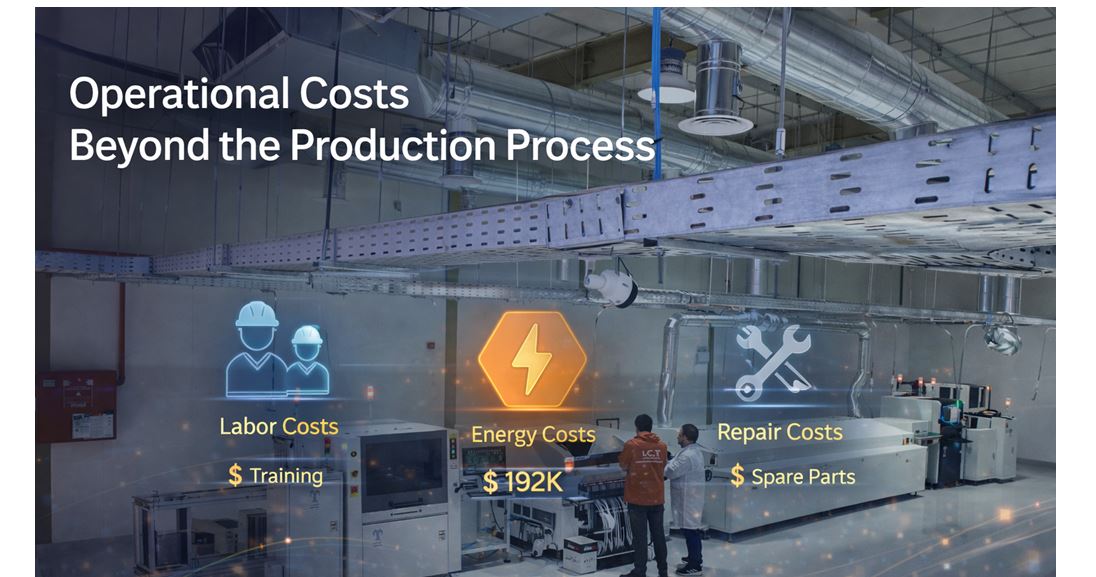
Lower-cost SMT lines often demand more manual intervention and skilled operators for setup, monitoring, and troubleshooting. This increases headcount and training expenses. Operators need ongoing instruction on complex software, error recovery, and quality standards.
3.2. Energy Consumption and Utilities
Reflow ovens and other thermal processes account for a large share of energy use in SMT facilities. Older or less efficient equipment consumes significantly more electricity and may require additional nitrogen or compressed air. Rising energy prices amplify this hidden cost.
4. The Real Difference: Low-Cost vs High-Reliability SMT Lines
4.1. Short-Term Savings vs Long-Term Cost
A side-by-side comparison reveals how initial price differences fade against ongoing expenses. A low-cost line might save $50,000–$100,000 upfront but incur higher annual operating costs through increased downtime, lower yield, slower changeovers, and greater maintenance needs.
4.2. Stability, Yield, and Throughput Comparison
High-reliability lines typically achieve first-pass yields of 99% or better, minimal unplanned downtime, and faster changeovers. These advantages translate into higher effective throughput and more consistent output, even if the theoretical placement speed (CPH) appears similar on paper.
5. How to Identify and Control Hidden Costs Before Investment
5.1. What to Evaluate Beyond Specifications
Buyers should examine real first-pass yield data, mean time between failures (MTBF), mean time to repair (MTTR), changeover times on actual products, and energy consumption under load. References from similar production environments provide valuable insight.
5.2. Questions Buyers Should Ask Suppliers
Key questions include local service response time, spare parts availability and pricing, training programs, software upgrade policy, and willingness to run trials with the buyer’s own boards. Suppliers who provide transparent TCO calculations and detailed case studies demonstrate confidence in their systems.
6. Building a More Cost-Efficient SMT Production Line
6.1. Process Stability as the Core Strategy
Stable processes — achieved through precise solder paste printing, accurate placement, controlled reflow, and effective inspection — form the foundation for low hidden costs. Closed-loop systems that automatically adjust parameters reduce variability and defects.
6.2. Using Automation and Data for Cost Control
Advanced inspection tools such as AOI and SPI, combined with data analytics, enable early defect detection and process optimization. Real-time feedback loops allow rapid correction of issues, improving yield and reducing rework. For manufacturers running varied products, high-flexibility SMT production lines that support quick changeovers while maintaining high stability deliver measurable reductions in hidden costs.
Summary of Key Points
Hidden costs in SMT production lines — primarily downtime, yield loss, changeover inefficiency, labor, energy, and maintenance — often exceed the apparent savings from low-price equipment. Calculating true TCO reveals that reliable, well-integrated lines deliver lower overall costs and higher profitability. Effective inspection technologies like AOI play a critical role in catching defects early, raising first-pass yield, and reducing rework. Buyers should evaluate suppliers on real performance data, service capability, and willingness to validate results with actual production conditions. Professional line planning and automation help turn potential hidden costs into measurable competitive advantages.
