
The way people usually approach the choice of a payment card for Facebook Ads is almost always flawed. Most discussions end up as simple lists of providers, issuing locations, or formal restrictions. That method may seem workable at the beginning, but it breaks down as soon as spending starts to scale, when billing behavior becomes erratic.
The core issue is that Facebook’s ad billing is governed not by the rules of everyday consumer banking, but by the mechanics of network-level risk management. Approval decisions are shaped by payment networks, issuing institutions, and the historical performance of specific BIN ranges inside advertising MCC categories. Within this framework, a card is not a consumer product, but a technical token that carries its own risk history.
This piece examines Facebook Ads payments from that exact angle. It also presents a comparative ranking of card providers that function reliably with Meta’s platforms, including Facebook.
The payment context of Facebook Ads as an advertising platform
When you fund advertising through Facebook Ads, you are dealing not simply with an online platform, but with a billing structure that banks and card networks label as elevated risk from the outset. This classification has nothing to do with the brand’s public image and everything to do with how the payment flow is technically designed.
Facebook operates on a post-charge system with flexible billing amounts and built-in elements of recurring transactions. For Visa and Mastercard, this hybrid structure triggers more intensive scrutiny of where the money comes from.
From the issuing bank’s perspective, these payments are grouped into dedicated risk segments that differ from standard subscriptions, ecommerce purchases, or SaaS charges. As a result, extra controls are imposed on cards used here, even when those cards are officially enabled for online transactions.
Facebook evaluates the card’s BIN risk profile
In real-world billing, Facebook almost never evaluates a transaction at the level of an individual card. Instead, its decisions are driven by the BIN — the initial six-digit code that identifies the issuing bank, the country of origin, the product category, and the baseline risk profile.
From Facebook’s standpoint, a card is not a user interface element but a record inside the card network’s BIN databases. Two cards that look identical in design, currency, and spending limits may perform in completely different ways if they belong to different BIN ranges. That is why selecting a provider based on outward characteristics rarely leads to consistent results.
A single BIN concentrates multiple risk signals: the issuing region, the card class (prepaid, debit, or commercial), past levels of refunds and chargebacks tied to that BIN, and its historical performance specifically within advertising MCC categories. Facebook analyzes this composite profile far more deeply than most standard merchants.
How Facebook interprets a BIN: parameters involved in decision making
The first factor Facebook reviews is the issuer’s country. The system checks whether the BIN’s issuing region matches the billing location of the ad account and the real geography of the traffic. A discrepancy does not trigger an automatic decline, but it lowers the initial trust score and reduces starting spending limits.
The second criterion is the card’s product category. Debit instruments are classified as account-linked, while prepaid ones are treated as balance-based. In a post-spend environment, this distinction is critical. Commercial BIN ranges generally tolerate a higher risk threshold, but only when the user passes the appropriate level of KYC.
The third element is the historical reputation of the BIN. Facebook relies on past statistics for declines and refunds within advertising segments. BINs that are frequently associated with arbitrage activity or trial campaigns gradually receive a downgraded risk coefficient.
Merchant category codes are reviewed as a separate layer of risk. Advertising transactions are routed through a dedicated classification and several related categories. Some BIN ranges may be formally approved for general online spending but still blocked when used for ad-related merchant codes. These restrictions are almost never documented openly and usually reveal themselves only during live billing operations.
Types of virtual cards for Facebook Ads
Cards issued on proprietary BIN ranges by fintech providers offer the highest degree of control, but they usually come with tougher identity verification requirements. Program-manager setups that operate through a sponsoring bank are fully shaped by the internal rules of that bank. White-label BIN ranges supplied by traditional institutions tend to start with a stronger trust baseline, although they sacrifice operational flexibility.
The real question is not which structure is objectively superior, but how each option is interpreted by Facebook’s risk scoring system. That perception is formed by the BIN’s past behavior in advertising MCC categories, its issuing region, and the profile of the clients using it.
Ranking of payment services for Facebook
Spend.net
Spend.net is a platform of virtual USD cards created specifically for advertising budgets and the anti-fraud behavior of major platforms. The service issues separate virtual cards for Facebook Ads, taking Meta’s internal payment verification algorithms into account.Which virtual cards work best for Facebook Ads payments
A separate advantage is the automatic 2% cashback on ad spend. It is credited directly to the card and shown in the dashboard in real time. The interface displays full transaction history, card spend, and fund movements with no hidden fees.
The technical setup is optimized for stable advertising payments: a pool of 20 BINs is used to reduce declined payments, team access with roles and spending limits is available, reports can be exported in CSV and XLS. 3D Secure is supported, top-ups in USDT and BTC are available, registration works via Google or email, and live chat support is available 24/7.
PSTNET
PSTNET is a specialized virtual card service tightly integrated with advertising platforms. The system has separate BIN pools for Facebook and other networks, as well as universal cards for mixed online payments and the Ultima card for general use.
The payment instruments are created for specific platforms and are intended to operate strictly within their respective ecosystems. Active teams can join the PST Private program with 3% cashback on ad spend and up to 100 free cards per month. New clients get their first USDT top-up with no fee.
All cards operate in Visa and Mastercard networks, with issuers located in the US and Europe. Security is handled with 3D Secure and two-factor authentication. Support is provided through a personal manager and messengers. PSTNET registration is fast, and KYC requires only a passport.
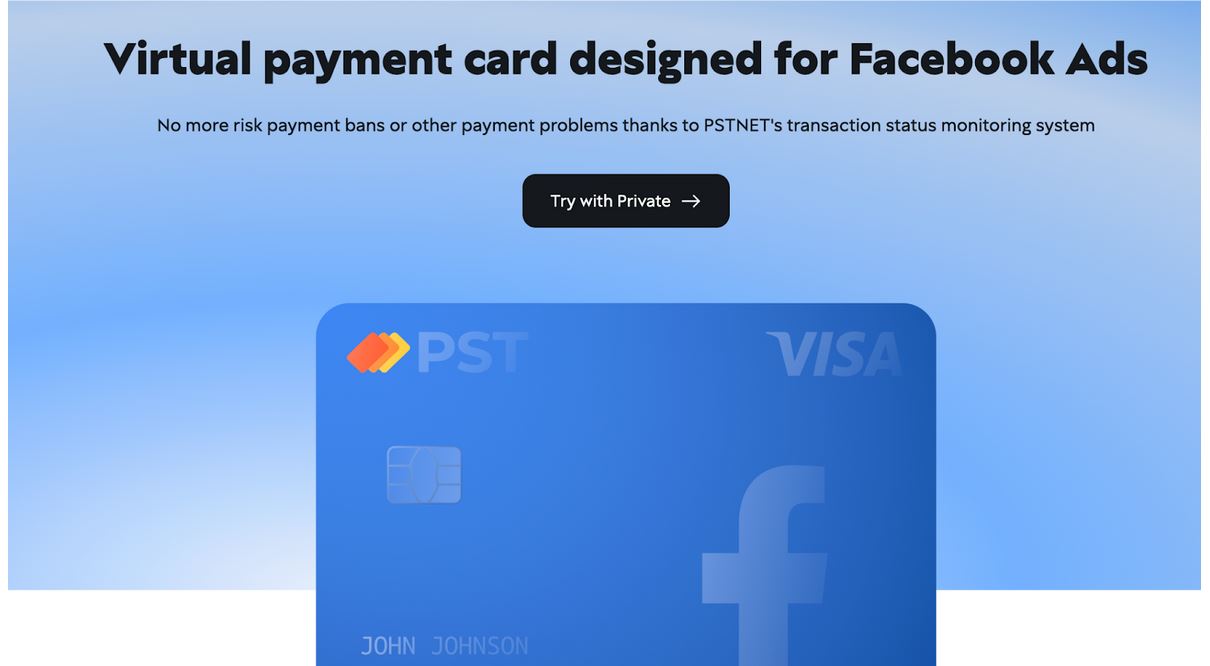
The service provides a full set of management tools, including a BIN analysis module showing typical spend levels, approval ratios, and billing caps, along with automatic balance refills, subaccount management, spending controls, and workflow assignment. The platform accepts a wide range of digital assets, supports international and regional bank transfers, and allows funding by card. No charges apply to payments, withdrawals, or operations involving blocked cards. All reporting and cashback information is updated and visible in real time.
MyBrocard (Brocard)
MyBrocard is focused on media buyers teams and agencies that operate large volumes of advertising accounts. The platform provides dedicated agency dashboards, programmatic access through an API, and a MassPayouts feature designed for large-scale outbound payments.
To start using the platform, users must add a fairly large initial balance. Transaction fees depend on how the account is funded, each payment includes a small base processing charge, and additional costs vary according to the merchant’s location and settlement currency. Declined payments are billed separately. Small withdrawals are subject to a fixed service fee.
The infrastructure runs across several dozen BIN ranges issued in multiple regions around the world. The service provides agency-level accounts, compensation for held funds, and programmatic access through an API. Opening an account requires full identity verification and a personal interview with a manager. The system is accessible only through a web interface and does not offer a mobile application.
Leading Cards
Leading Cards is a platform built for advertising and arbitrage teams, including those operating high-risk campaigns. Its payment instruments are reliably accepted by Google, TikTok, and other ad networks, while the available BIN pools are refreshed on a regular basis.
The platform allows billing addresses to be customized for individual ad accounts and supports fully personalized digital cards. High-volume clients can access VIP terms, which include free creation, a wider choice of BINs, and custom pricing models.
Standard issuance begins at $6, with an optional activation charge of $5. Funding with cryptocurrency carries a 4.2% fee, while bank transfers are charged at 3%. Monthly service fees start at $5. Payments processed outside the United States are subject to a 2% surcharge, and separate fees apply to refunds and currency conversions.
Users can choose from 12 to 40 different BIN ranges and use team management tools through MyTeams, including spending limits and internal balance transfers. The platform supports USDT, BTC, ETH, and WIRE funding methods. Corporate clients and compliant “white” operations must complete extended verification, although in certain cases crypto onboarding is possible without KYC.
Karta.io
Karta.io is an American card-issuing platform created for large companies and professional media buying teams. All payment instruments are issued in digital form, operate exclusively in US currency, and include built-in secure authentication. The service is mainly used for advertising on major social platforms, with limited support for search campaigns.
Only companies registered in the United States are eligible to apply, and full identity verification is mandatory.
Final thoughts
When you look at a virtual card as a network object rather than a convenient interface, the choice becomes much more predictable. That understanding is what separates stable ad accounts from those constantly searching for a new card.
