
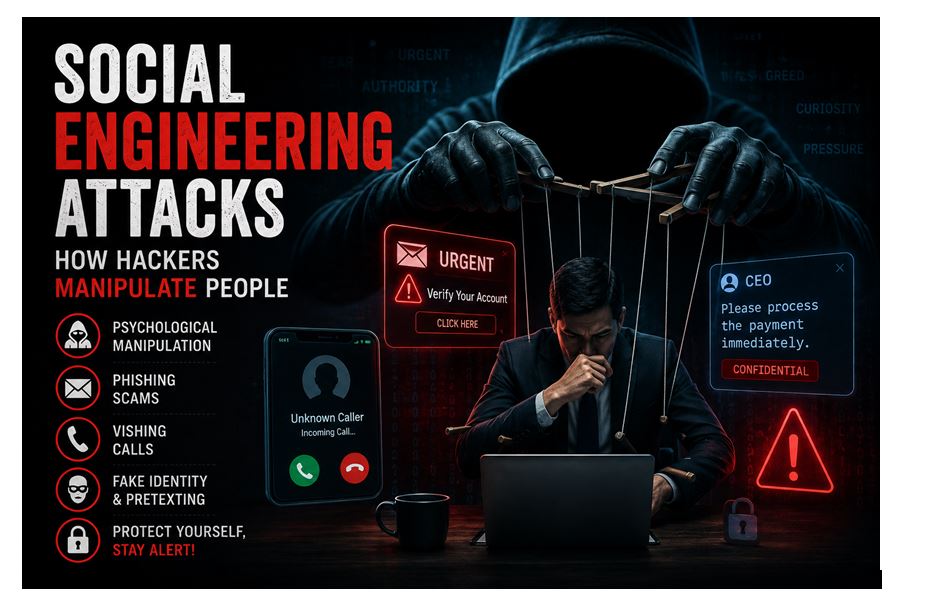
Imagine losing your savings because you trusted one fake email. That fear keeps millions of people awake at night. Scammers don’t need advanced code to hurt you. They just need your trust. Social engineering attacks exploit that trust every single day. The good news? Once you understand how these tricks work, you can spot them fast and protect yourself before any damage happens.
Social engineering attacks rely on manipulation, not malware. Hackers study human behavior instead of breaking firewalls. In this article, you’ll learn the common attack types, the psychological tricks behind them, and practical steps to defend yourself. You’ll also find real questions people ask online, answered simply. Let’s get started.
What Are Social Engineering Attacks?
Social engineering attacks trick people into revealing sensitive information. Instead of hacking systems, attackers hack minds. They pose as trusted figures like coworkers, banks, or tech support agents. Consequently, victims hand over passwords, financial details, or building access willingly. This form of cyber deception works because humans naturally want to help others. Attackers exploit that instinct through fake urgency or authority. Therefore, even cautious people fall for well-crafted scams.
Unlike traditional hacking, these schemes need no coding skills at all. A convincing story and confident tone often suffice. That simplicity explains why criminals favor this approach worldwide. Furthermore, these attacks affect individuals and organizations equally. A single successful attempt can expose thousands of customer records. Understanding this risk is the first step toward real protection.
Common Types of Social Engineering Attacks
Hackers use several proven methods to manipulate targets. Each method targets a different weakness in human judgment.
Phishing and Spear Phishing
Phishing remains the most widespread attack method today. Attackers send fake emails that mimic real companies. These messages often contain malicious links or infected attachments.
Meanwhile, spear phishing targets specific individuals with personalized details. Attackers research their victims beforehand for maximum credibility. As a result, spear phishing success rates stay alarmingly high.
Vishing and Smishing
Vishing uses phone calls instead of emails to deceive victims. Scammers pretend to be bank representatives or government officials. Similarly, smishing delivers scam links through text messages.
Both methods create urgency to bypass careful thinking. For instance, a fake “account suspended” text pushes instant action.
Pretexting
Pretexting involves inventing a believable false scenario. Attackers might pose as auditors, vendors, or new employees. This fabricated story helps them extract confidential information smoothly.
Baiting
Baiting dangles something tempting to lure victims in. A free download or an abandoned USB drive works well. Once clicked or plugged in, malware infects the system instantly.
Quid Pro Quo Scams
This tactic offers a fake favor in exchange for access. Attackers might pose as tech support fixing a nonexistent issue. Victims willingly share credentials during this staged interaction.
Tailgating and Piggybacking
Tailgating happens in physical spaces, not online platforms. An attacker follows an authorized employee into a restricted area. Since nobody questions a confident stranger, access gets granted easily.
CEO Fraud and Business Email Compromise
Business Email Compromise (BEC) targets company finances directly. Attackers impersonate executives to request urgent wire transfers. Unfortunately, this scam costs businesses billions annually worldwide.
Finance teams often trust internal requests without question. That trust becomes the exact weakness attackers exploit. Consequently, a single approved transfer can drain company accounts instantly.
Real-World Impact of Social Engineering Attacks
Major companies across every industry have suffered from these schemes. Attackers rarely need sophisticated tools to succeed. Instead, they rely on patience and careful research beforehand. For example, employees have wired millions after one convincing phone call. Similarly, hospitals have paid ransoms following a single phishing click. These cases prove that human error, not weak software, causes most breaches.
Additionally, small businesses often underestimate their own risk level. Attackers specifically target them due to weaker internal controls. As a result, recovery costs frequently exceed what these companies can afford.
Why Social Engineering Attacks Work So Well
Social engineering attacks succeed because they target emotions, not technology. Attackers manipulate specific psychological triggers to control behavior.
Here are the main levers hackers use:
- Authority: Pretending to be a boss or official
- Urgency: Creating panic through fake deadlines
- Fear: Threatening account suspension or legal trouble
- Curiosity: Offering irresistible links or downloads
- Trust: Mimicking familiar brands or contacts
- Reciprocity: Offering small favors before asking for something big
Consequently, victims react emotionally instead of thinking logically. This emotional hijacking is exactly what makes identity theft and data breaches so common. Interestingly, attackers often combine several triggers within one message. A fake invoice might carry urgency, authority, and fear together. This layered approach makes the deception feel far more believable.
Recognizing these triggers gives you a real advantage. Once you notice panic rising, treat that feeling as a warning sign. Genuine emergencies rarely require instant, unverified action.
How to Protect Yourself From Social Engineering Attacks
Fortunately, defending against these threats doesn’t require technical expertise. Simple habits reduce your risk dramatically.
Practical Defense Steps
- Verify requests through a separate, trusted channel
- Never click links from unexpected messages
- Check sender addresses carefully, not just names
- Enable multi-factor authentication on every account
- Attend regular security awareness training sessions
- Limit access using least-privilege principles at work
- Report suspicious messages to your IT team immediately
Additionally, organizations should run simulated phishing tests often. These exercises build lasting awareness among employees. Over time, this habit reduces successful credential theft significantly.
Building Long-Term Cyber Awareness
Awareness grows stronger through consistent practice, not one training session. Therefore, companies should treat security education as an ongoing process. Employees who understand manipulation tactics rarely fall for them twice. Moreover, personal vigilance matters just as much as workplace policy. Pause before reacting to urgent digital requests. That single pause often prevents a costly mistake.
Finally, families should discuss these risks together at home. Older relatives and children face targeted scams too. Sharing knowledge across generations builds a stronger collective defense.
Frequently Asked Questions
Q1. What is the most common social engineering attack?
Phishing remains the most common attack. It uses fake emails to steal credentials or spread malware through infected links.
Q2. Can social engineering attacks happen over the phone?
Yes, vishing scams use phone calls. Attackers impersonate banks or officials to extract sensitive personal or financial information quickly.
Q3. How do I know if I’m being socially engineered?
Watch for urgency, unexpected requests, or unfamiliar senders. Legitimate organizations rarely demand instant action or secret information.
Q4. Do small businesses face this threat too?
Absolutely, small businesses are frequent targets. Attackers assume smaller teams have weaker data breach defenses and less training.
Q5. Does antivirus software stop social engineering attacks?
Not entirely, since these attacks target people, not software. Awareness and verification habits matter more than antivirus alone.
Conclusion
Social engineering attacks continue evolving alongside technology itself. However, understanding these tactics puts you firmly back in control. Hackers rely on panic, trust, and distraction to succeed. By staying alert and verifying requests, you remove their biggest advantage. Don’t wait until you become another statistic in this growing threat. Start applying these defense habits today, and share this guide with your team to build a safer digital environment for everyone.
