
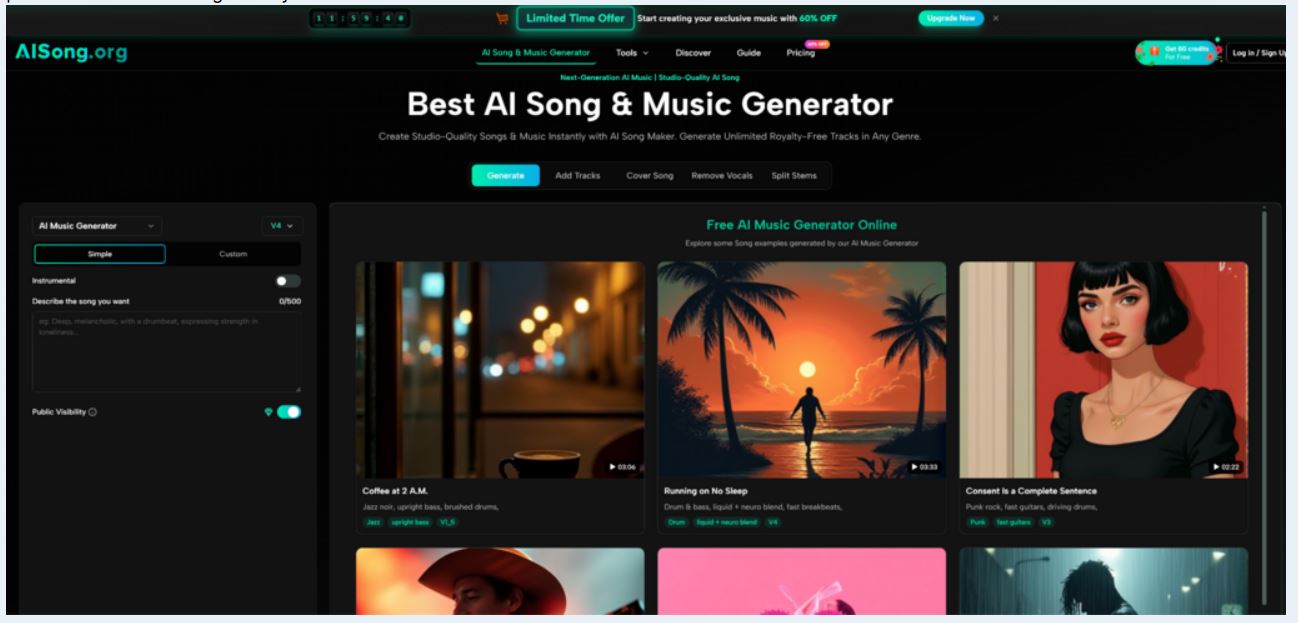
People often imagine AI music tools as either magical or useless. In reality, most of them sit somewhere in the middle. They can be genuinely helpful when used for the right purpose, but disappointing when asked to solve every part of music creation at once. That is the right mindset for reviewing an AI Song Generator: not as a miracle replacement for songwriting, but as a tool that may speed up idea testing, drafting, and revision.
Viewed through that lens, AISong makes a stronger first impression than many simplified web generators. The public site shows a broader music workflow than a basic text-to-audio page. It includes model selection, lyric generation, lyrics-to-music conversion, vocal removal, stem splitting, cover-style generation, track layering, and song extension. That does not automatically guarantee quality, but it does suggest a platform built around process rather than a single flashy action.
First Impressions Of The Product Structure
The product’s design language appears aimed at clarity. Users are shown a generation area with different modes, core text fields, optional advanced settings, and supporting tools. That is important because music creation can become intimidating very quickly when interfaces feel too technical.
AISong seems to avoid that problem by keeping the workflow visible. The basic steps are easy to understand even for non-specialists, while the deeper tools remain available for users who want more control later.
The Entry Experience Looks Thoughtful
The ability to choose between simple and custom creation paths is one of the site’s more sensible design choices. It acknowledges that not all users begin from the same kind of material.
A beginner may only know the mood, genre, and emotional energy. A more intentional user may already have lyrics and structure. Allowing both entry points makes the product feel more inclusive without making it feel unfocused.
The Platform Seems To Favor Momentum
In my observation, the best browser-based creative tools do one thing especially well: they keep the user moving. AISong appears built with that principle in mind. The site encourages quick starts, visible model decisions, and follow-up actions after generation. That helps prevent the common problem where a tool produces one output and then leaves the user with nowhere useful to go next.
How AISong’s Workflow Holds Up
The public guide presents a workflow that is neither too shallow nor too technical. That balance is probably one of the product’s biggest strengths.
Step 1: Choose Your Input Style
Users can either describe a song in plain language or work from lyrics. This is more important than it sounds because creative intent often arrives unevenly. Some people hear a mood before they hear words. Others write words before they know the arrangement.
Why This Feels Like Good Product Design
A rigid tool would force one path. AISong’s two-path structure respects how songs actually begin for different users. That alone makes the site more usable over repeated sessions.
Step 2: Match The Model To The Task
AISong publicly identifies several model versions and explains them in terms of quality, experimentation, and cost. That is a strong sign because it gives users expectations rather than hiding trade-offs.
Why This Improves The Review
From a reviewer’s perspective, model transparency is a meaningful advantage. It tells users that quality differences are part of the platform’s logic, not something they are supposed to guess after paying.
Step 3: Make Directional Adjustments
AI Song Maker includes settings that affect vocal choice, style adherence, and in some workflows how strongly new material follows an existing audio source.
Why Limited Control Still Helps
These are not exhaustive production controls, but they do make the product feel more intentional. They help users reduce creative drift and keep the generated result closer to the original idea.
Step 4: Continue Working After Generation
AISong supports regeneration and exposes several next-step tools. This is one of the more professional aspects of the product, because it recognizes that first outputs are often provisional.
Why This Matters In Real Use
A user may like the lyrics but dislike the vocal tone. They may like the arrangement but want a longer version. They may want a karaoke track, isolated stems, or a different variation using the same style settings. AISong seems to support that kind of practical continuation.
Feature Areas That Actually Add Value
A long feature list means very little if the features do not connect to realistic use. AISong’s stronger point is that many of its tools do connect logically.
Lyrics Support Gives The Platform Range
The inclusion of AI lyrics support and lyrics-to-music generation broadens the product’s usefulness. It makes the site relevant to people who think in narrative or phrase form rather than purely musical terms.
For writers, this matters a lot. Instead of stopping at a lyric page, they can move directly into audio testing without changing platforms.
Song Extension Supports Iterative Building
The extend-song function suggests a workflow where tracks do not need to be complete on first generation. A user can treat the first version as a draft and then build outward from it.
That approach fits modern creative behavior well. People often prefer to see whether a song has potential before deciding how much time it deserves.
Separation Tools Improve Reusability
The presence of both vocal removal and stem splitting is a real plus. These functions give the generated output secondary life. Instead of only listening to the final mix, users can break it apart for other purposes.
Why This Is More Than A Bonus Feature
Generated music becomes more useful when it is modular. Instrumentals can support content creation, stems can support remix-minded work, and isolated vocals can help analysis or experimentation. That gives AISong more depth than tools that stop at download.
Track Layering Fills A Real Creative Gap
The add-tracks feature is especially practical. Many creators do not start with full songs. They start with beats, lyrics, or vocal ideas. A platform that helps combine those pieces solves a very real problem.
AISong Performance By Use Case
| Use Case | Relevant AISong Capability | Review Perspective |
| Quick idea checking | Simple mode generation | Strong for reducing friction |
| Lyric-based song drafting | Custom mode and lyric assistance | Useful for non-producers and writers |
| Revising an early draft | Regenerate and extend song | Supports comparison and refinement |
| Repurposing generated material | Vocal remover and stem splitter | Good practical flexibility |
| Completing partial concepts | Add tracks workflows | One of the more valuable features |
Where The Platform Feels More Limited
A balanced review should also point out where expectations need to stay realistic.
It Still Depends On Clear Input
No matter how broad the feature set is, generative music still responds strongly to prompt clarity and lyric quality. Users who are vague will likely get weaker results. The platform can interpret direction, but it cannot fully rescue an unclear idea.
It Is Best Treated As A Drafting Tool
In my view, AISong looks strongest as a drafting and workflow tool rather than a final-production replacement. That is not criticism. It is simply the role it seems best suited to. The platform helps users hear, compare, revise, and extend ideas quickly.
Serious Final Polish May Still Happen Elsewhere
Advanced producers may still want dedicated environments for detailed arrangement and finishing. AISong appears more focused on generation, exploration, and accessible manipulation than on deep studio precision.
Who Will Probably Get The Most From It
AISong seems particularly useful for solo creators, lyric-first users, content producers, and anyone who values speed without wanting a shallow experience. It is also appealing for users who want to keep everything in one browser-based system instead of moving across several disconnected tools.
Why It Stands Out In That Segment
Its advantage is not only that it generates songs. It is that it supports what comes next. That makes the site feel more durable, especially for users who revisit ideas rather than discarding them after the first output.
Overall Review In Plain Terms
AISong looks like a thoughtful online music creation platform with a wider workflow than many entry-level competitors. Its main strength is not one individual feature, but the way the features fit together. Users can start simply, move into deeper control, regenerate when needed, and keep shaping the result through extension, separation, or track layering.
The platform will still require patience, clear intent, and selective judgment. Not every generation will be strong, and not every user will treat the output as final. But for people who want a professional-feeling browser tool that remains understandable, AISong appears to strike a good balance between power and usability. That balance is hard to get right, and it may be the clearest reason this site feels worth serious attention.
