

If you ever wanted to be an entrepreneur, now is the best time to do so.
Anyone has a fighting chance to turn ideas into profitable business websites.
Everything you need to stop, drop, and set up an online shop is only a few clicks away — from drag-and-drop website builders to CRM software that will help you grow your customer base. Better yet, plenty of these solutions are self-service, which means they’re manageable even for one-man teams.
Not familiar with online business tools? The internet is filled with free learning resources that can teach you what to do.
This post, for instance, discusses the ways to start from scratch and build a marketable website.
If you’re serious about being an online entrepreneur, then this post is for you.
Let’s go.
1. Research Your Niche
Ever heard of the saying, “follow your passion”?
In the online world, that’s not always true.
Let’s face it — not all passions can be turned into profitable businesses. More importantly, most profitable business ideas are already saturated with competitors, especially if we’re talking about online businesses.
However, that doesn’t mean you should give up on your niche altogether.
With research, you can always find sub-niches that still has room for new players.
How to Narrow Down Your Niche
To find a sub-niche, the most straightforward tactic is to use Google Autocomplete.
Basically, all you need to do is enter any relevant keyword or phrase in your niche, add the word “for,” and wait for Google to provide suggestions.
For example, if you aspire to build a graphic design agency, then the phrase “graphic design for” should do nicely.
Google should immediately provide you with a list of sub-niches that you can specialize in:

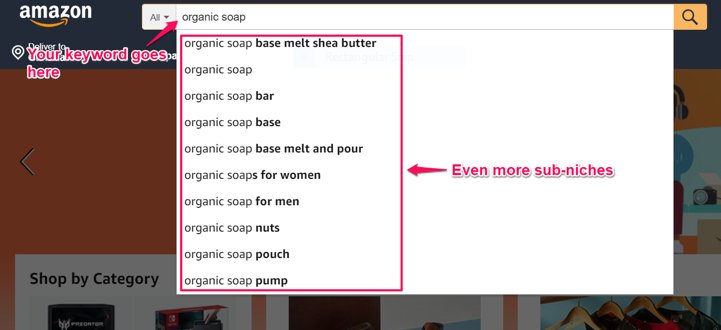
If you’re interested in e-commerce, you can use the same strategy with the built-in search engines of websites like Amazon.
Here’s an example with the keyword “organic soap” to help you understand how this works:
Already spotted a niche you’re interested in?
Don’t get too excited — you still need to measure the demand for a specific sub-niche to make sure it’s worth pursuing.
This takes us to the next step.
2. Use a Keyword Research Tool
Using a keyword research tool lets you accomplish two things at once.
First, it can present you with even more niche ideas you can undertake.
Second, it will give you an idea of how profitable a niche is based on the number of searches a keyword gets per month. Tools like Ubersuggest also rate the competitiveness of keywords to help you avoid going head to head against bigger, better-funded brands.

On Ubersuggest, the recommended competitiveness rating for new businesses is around 30. Since the keyword used above is a tad over this, head over to the “Keyword Ideas” tab to discover other keyword opportunities as well as potential sub-niches to explore.
When performing keyword research, it’s important to pick a diverse pool of keywords to improve your chances of ranking and draw in a larger crowd.
Keywords also help you come up with a unique value proposition that can make your brand stand out — a crucial requirement before you should start building landing pages for your website.
3. Creating Your Website
The good news is, developing your website from the ground up is actually one of the easier steps in building an online business.
Even without any experience in web development, anyone can get a professional-looking website up and running in no time. You just need to choose the right platform with the tools necessary to give your ideas some legs.
For example, if you’re planning to build an online store, then investing in an e-commerce platform like Shopify or BigCommerce is a cost-efficient way to go.
This is because these platforms already have all the features you need to build and manage a full-fledged virtual shop in one package.

A lot of would-be online entrepreneurs, however, pick a content management system like WordPress for flexibility and long-term scalability.
Sure, the site-building process with WordPress may not be as intuitive or streamlined as Shopify or BigCommerce. It does, however, give website owners more room for customizability — along with thousands of plugins that make it easy to integrate features like booking calendars to image sliders.

Whichever platform you choose, it’s imperative that you design your website with user experience in mind in order to maximize conversions.
Below are some of the proven ways to do this:
- Prioritize readability over visual fidelity
- Pay attention to mobile-friendliness with a tool like the Mobile-Friendly Test
- Emphasize key conversion elements like value propositions, headlines, and CTA buttons
- Reduce friction by eliminating unnecessary steps, like forced subscriptions and full-screen ads
- Use PageSpeed Insights to help improve your website’s loading speed
4. Engineer an Ongoing Content Strategy
While building a site can be considered as easy, filling it up with high-quality content that resonates with your audience is the exact opposite.
It takes hours — if not days — of research, writing, proofreading, and search engine optimization just to publish a single post.
Keep in mind that your website’s content is the building block of your brand. You can’t afford to cut corners since your authority is at stake.
Although a content development strategy deserves a full-length article of its own, we can set you off in the right direction with the following guidelines:
- Do Your Keyword Research
Keyword research tools not only help you find potential content ideas. They also help you find lucrative ranking opportunities that will draw the right crowd. - Understand Your Audience’s Preferences
Look at your top competitor’s website to grasp the content preferences of your target audience. - Use Tons of Visual Content
To capture your target audience’s attention, don’t skimp on visual content such as infographics and featured images. You can outsource graphic designers from Fiverr on the cheap or build your own with a cloud-based tool like Canva.
Conclusion
Being able to pursue your passion is a privilege not given to all.
The question is, how are you going to make the most out of it?
With the strategies above, it’s only a matter of time before you start seeing the results of your new online endeavor. It won’t happen overnight, but as long as you establish the right foundations — from target keywords to content development — then you only have success to look forward to. Good luck!

Author: 99 Tech Post
99Techpost is a leading digital transformation and marketing blog where we share insightful contents about Technology, Blogging, WordPress, Digital transformation and Digital marketing. If you are ready digitize your business then we can help you to grow your business online. You can also follow us on facebook & twitter.