
Choosing the right React UI library can make or break an enterprise application. Enterprise Web Application framework demand robust features, high performance, scalability, and maintainability. Selecting the appropriate React component library is essential for creating scalable, maintainable, and user-friendly enterprise solutions. Today, three prominent libraries stand out for building rich user interfaces in React: ReExt, MUI (Material-UI), and Ant Design.
All three have their strengths, but which one wins for enterprise apps? In this detailed comparison, we’ll explore various angles – from component breadth and performance to customization and support – to see why ReExt emerges as the top choice for enterprise front-end development.
ReExt vs MUI vs Ant Design: Overview of Enterprise App Libraries
Quick Overview of Each Library
React UI frameworks are a multitude of options to modern front-end developers. The most popular open-source libraries include MUI (previously Material-UI) and Ant Design (AntD), both of which have a large community and a large amount of components. ReExt is a relative newcomer though that fills the gap between Sencha, the Ext JS components powerhouse, and React, as it seeks to add enterprise-grade UI components to the React ecosystem.
ReExt (Sencha Ext JS in React): A React UI library providing direct integration of over 140 pre-made components of Sencha Ext JS. It has its attention on business applications such as powerful data grids, pivot tables, charts, trees, calendars, and rich forms. ReExt is created to create data-intensive and high-performance applications with little effort, and at the same time, use professional support and continuous updates.
MUI (Material-UI): an open-source React library of components covering the Material Design system at Google. MUI offers a refined collection of standard elements (buttons, forms, dialogs, tables, and so on) in a uniform Material appearance and feel. It is characterized by huge community, a high level of documentation and useability. Good at adding a familiar, clean UI to an application quickly, though some of its more complex components (e.g. complex data grids) will need other paid packages or workarounds.
Ant Design (AntD): Alibaba created an all-inclusive open-source React-based UI. Ant Design provides an extensive selection of elements to use in enterprise applications such as tables and forms or charts (through AntV) or elements of navigation. It is default elegant (inspired by Ant Design guidelines) and allows such features as internationalization and design theming through Less. AntD is also popular with admin dashboards and large apps, but is heavy and more difficult to pick up in order to make fine-grained customization.
Comparison Table of “Component Library and Feature Set
| Category | ReExt | MUI (Material UI) | Ant Design (AntD) |
| Core Framework | Built on top of Ext JS + React (bridging enterprise-grade Ext JS components with React flexibility) | Built with React, following Google’s Material Design principles | Built with React, following Ant Financial’s design system |
| Component Density | ~140+ ready-to-use enterprise components | ~60+ core components | ~70+ core components |
| Design Philosophy | Data-driven, enterprise-grade UI/UX optimized for business dashboards, data grids, and BI apps | Focused on clean, minimalist Material Design for modern web apps | Emphasizes elegant, consistent design with strong UI cohesion |
| Data Grid / Table | Extremely advanced — hierarchical grids, pivot grids, infinite scrolling, cell editing, live updates | Basic DataGrid (via XGrid Pro for premium users) | Moderate — supports filtering, pagination, sorting (less scalable for very large datasets) |
| Charting Library | Integrated charting suite (line, bar, area, pie, radar, gauge, etc.) with SVG + Canvas rendering | Relies on external libs (e.g., Recharts, Chart.js) | Relies on external libs (e.g., BizCharts, ECharts) |
| Layout System | Robust layout engine (border, card, accordion, hbox, vbox, responsive containers) | Flexbox/Grid-based responsive system | Flexbox/Grid-based responsive system |
| Theming | Customizable via Sencha Themer and CSS variables, supports enterprise branding | Theme customization via Emotion or MUI ThemeProvider | Theming via Less variables or CSS-in-JS (customizable tokens in v5) |
Performance and Scalability
Enterprise applications often deal with large data volumes and complex UI interactions. How do ReExt, MUI, and Ant Design compare in terms of performance?
- ReExt Performance: Performance is a cornerstone of ReExt’s design. Since ReExt is built on the Ext JS core (a framework renowned for handling large data sets efficiently), it benefits from decades of optimization for enterprise use-cases.
Key performance advantages include:
- Highly optimized data grid components that support virtual scrolling (only rendering what’s visible) and buffered data stores. This means even if you have tens of thousands of rows in a table, the UI remains responsive and smooth.
- Efficient algorithms in trees and lists for handling deep hierarchies or long lists without choking the browser.
- The component architecture often uses internal batching of updates to avoid excessive re-renders, making complex screens render quickly. ReExt’s integration ensures these optimizations carry over into React without causing reconciliation issues.
- Layout and rendering engine from Ext JS is optimized in JavaScript to calculate layouts and sizing efficiently, reducing reflows and repaints in the browser.
- MUI Performance: MUI is built with modern React best practices and generally delivers good performance for typical use cases. For most standard-sized applications or moderate data sets, MUI’s functional components and hooks will keep the app snappy.
However, there are some considerations:
- Large Data Grids: As noted, the basic MUI Table is not virtualized, so rendering thousands of rows can severely impact performance. The MUI X DataGrid Pro (commercial) introduces virtualization and other performance improvements. Without it, a developer might experience lag in very large tables or resort to third-party grid components.
- Ant Design Performance: Ant Design provides robust components but can be somewhat heavier in bundle size and runtime compared to MUI. Some points on performance:
- The library includes a lot of features by default, and historically the bundle size of AntD was considered large. Tree shaking and importing only needed components is possible, but if used naively, an AntD-based app might send a lot of code to the client. This can affect initial load performance if not managed.
- Runtime performance for most components is quite solid. AntD tables, for instance, support some performance features like virtualization via additional packages or props (e.g., using virtual-list for long tables). Still, out-of-the-box, an AntD table rendering thousands of rows might be slow without enabling such features or pagination.
Theming and Styling Flexibility
In enterprise products, having a consistent look-and-feel that matches company branding or design guidelines is crucial. How flexible and easy is it to theme each of these libraries?
- ReExt Theming: ReExt inherits a robust theming system from Ext JS. It comes with several pre-built themes and allows extensive customization:
- Right out-of-the-box, ReExt offers multiple modern themes (as listed in Sencha Ext JS, such as “Material”, “Triton”, “Neptune”, “Graphite”, “Classic”, etc.). These themes provide different aesthetic choices – for instance, a Material-inspired look, an iOS-like look, classic Ext JS look, etc. Having these available means you can switch the overall look of your app with minimal effort.
- For deeper customization, Sencha provides the Themer tool, which lets developers or designers visually tweak theme settings (colors, font sizes, paddings, etc.) and generate a custom theme without diving into Sass or CSS directly. This is a huge plus for enterprise teams that might not want to hand-code every style – Themer can ensure a brand’s style guide is applied uniformly across all components.
- Underneath, Ext JS (and thus ReExt) uses Sass and a theming pipeline that can be extended. If needed, you can customize at a granular level (overriding variables or writing custom CSS) to get just the look you want, but often the built-in themes cover most needs with a few variable tweaks.
- Another key aspect: Because all of ReExt’s components come from one integrated library, the styling is consistent across components by default. There’s no patchwork of different design languages – everything feels cohesive (which is important for user experience in enterprise apps).
- Dark mode or multiple theme support: Ext JS supports dynamic theme switching (with proper build configurations). ReExt can leverage this to provide both light and dark themes if your app requires theme toggling, ensuring accessibility and user preference support.
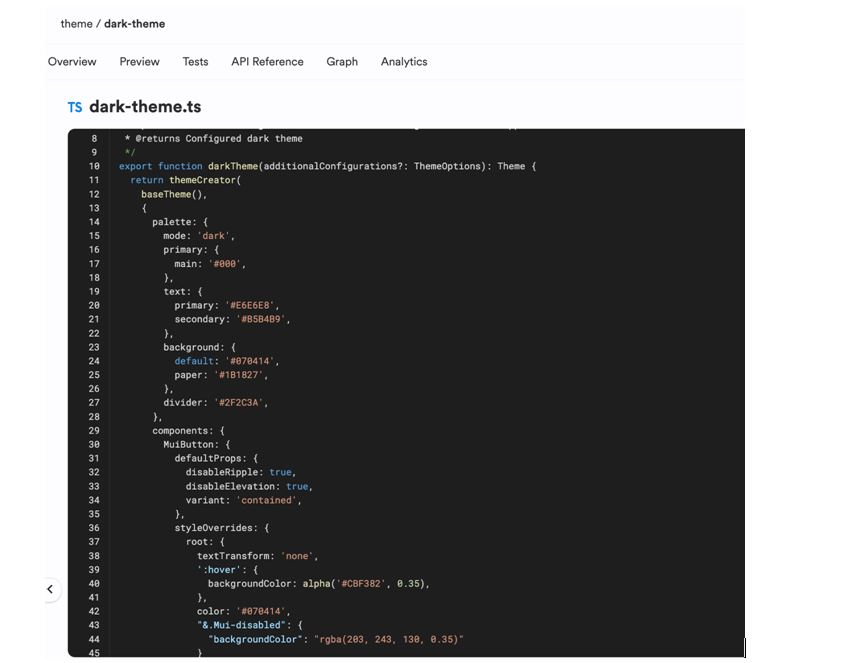
- MUI Theming: MUI is well-known for its theming capability. Since it’s built around Material Design, it encourages the use of a centralized theme object:
- Developers can use a ThemeProvider to set up custom themes. MUI exposes a large set of design tokens (colors, typography, spacing, breakpoints, etc.) that can be customized globally. For example, you can easily change the primary and secondary color palettes of your app to match brand colors, adjust default border radius for components, or set global font family through the theme.
- MUI supports dark mode theming out-of-the-box. The library provides a straightforward way to switch to a dark palette and adjust component styles accordingly.
- Fine-grained styling can be done via various methods: the older makeStyles or withStyles APIs, or the newer sx prop and styled components approach. This flexibility means developers can override or extend component styles on a case-by-case basis when needed. For instance, if the default Button isn’t exactly as desired, it’s easy to apply additional CSS or even create a variant through the theme to apply a new style consistently.
- Ant Design Theming: Ant Design’s styling approach revolves around Less/CSS variables and a set of predefined design tokens:
- AntD comes with a default theme which has a very clean, professional look (blue accents, rounded corners, etc.). It also provides a dark theme and supports customization primarily by overriding Less variables.
- Using a tool or modifying a Less file, you can change things like the primary color, font sizes, border radius, etc. Ant Design publishes a list of theme variables (for example, @primary-color, @font-size-base, @border-radius-base, etc.) that control the design system. By changing these and recompiling the styles (or using their dynamic theme plugin), you get a custom theme.
- The process of theming is not as straightforward as MUI’s JavaScript object approach since it involves build-time style overrides or using their theming plugin. It’s doable but can be complex especially if one is not familiar with Less or build tools. Some developers have found applying a fully custom theme in AntD to be a bit time-consuming (as anecdoted by spending a day tweaking config to get a client’s design exactly right).
- On the plus side, AntD’s components all adhere to the theme variables, so once you get those right, your entire application will reflect the new styling consistently. The design consistency of AntD is excellent – like ReExt, all components feel part of a single design language (the Ant Design language).
Support, Community, and Maintenance
Enterprise development isn’t just about coding features; it’s also about long-term maintenance, getting help when needed, and ensuring the library stays updated and secure. Here’s how ReExt, MUI, and Ant Design compare in terms of support and community:
- ReExt Support & Maintenance: ReExt is a commercial product by Sencha, which means it comes with official support and a well-defined maintenance roadmap:
- Professional Support: With ReExt (available under Pro and Enterprise licenses), teams get access to Sencha’s support services. This means if you encounter bugs, performance issues, or need guidance, you have experts to turn to. For mission-critical enterprise applications, having that dedicated support can be invaluable – it reduces risk and saves time compared to solely relying on community help.
- Continuous Updates: Sencha has a track record of continually updating Ext JS for new browser capabilities, performance improvements, and security patches. ReExt benefits from that ongoing development. The site emphasizes that they are “constantly improving and updating” the library to provide the latest features and security updates. Enterprise teams can be confident that the library will not stagnate – new enhancements (for example, support for newer React versions or new UI components) are regularly rolled out.
- Documentation and Training: Being a product, ReExt comes with formal documentation, tutorials, and even training services from Sencha. In addition, Sencha runs webinars and provides an Upgrade Adviser to help migrate or upgrade projects smoothly. This level of hand-holding is quite useful for enterprises that need to onboard their team or update large applications with minimal hiccups.
- Community and Ecosystem: While ReExt is newer and its community is growing, it leverages the existing Ext JS community and knowledge base built over years. Sencha forums, StackOverflow, and a Discord channel are available where developers discuss tips and troubleshoot. As mentioned on Sencha’s site, ReExt’s community is active and growing, meaning more third-party contributions, examples, and shared solutions will become available over time. It may not yet match the sheer size of MUI’s community, but it’s backed by the stability of a company which often means consistent progress and fewer abandoned issues.
- MUI Community & Maintenance: MUI is an open-source project (MIT licensed) that has become one of the most starred React libraries on GitHub:
- Large Community: MUI’s community is massive. There are countless resources – third-party blog posts, YouTube tutorials, and discussion threads – given its popularity. This means if you run into a problem, chances are someone has already asked it and gotten an answer. The benefit of this crowdsourced knowledge cannot be overstated; tight deadlines become easier when Stack Overflow has your answer.
- Open-Source Development: MUI is actively maintained by a core team (which operates a company around MUI X, etc.) and many contributors. It receives frequent updates, bug fixes, and new components. However, as an open project, support is community-driven. There is no official support line (unless you engage a third-party or the MUI team’s commercial offerings). For many, the community suffices, but enterprise teams should consider if they need guaranteed response SLAs which only a paid support can provide.
- Documentation: MUI’s docs are well-maintained, and they also provide migration guides for major version changes (e.g., from v4 to v5). This is important for maintenance as React itself and MUI evolve – you want to ensure you can upgrade with minimal friction.
- Longevity: Given its widespread adoption and backing (the MUI core team is funded by premium product offerings), MUI is likely to remain a stable presence in the React ecosystem. Still, it’s community-driven; sometimes feature requests or fixes might not align with your timeline, whereas in a commercial product you might have more influence via support channels.
- Ant Design Community & Maintenance: Ant Design also enjoys a robust community, though somewhat more concentrated in certain regions (very popular in China/Asia, gaining worldwide usage too):
- Active Development: Ant Design is maintained by developers at Alibaba and the community. It sees regular releases and improvements. They are often quick to support new React versions and add components. The presence of a corporate backer (Alibaba uses AntD in its own products) adds confidence that the project will be maintained in the long run.
- Community Support: There’s a significant community around AntD – multiple forums, an active GitHub repository where issues are discussed, and plenty of articles. The documentation site even provides design guidelines and recommended practices, which is useful for new teams adopting it.
- Support Model: Unlike ReExt, AntD does not come with official support contracts since it’s free/open-source. Enterprise users must rely on community or hire experienced Ant Design developers. Some third-party consulting firms might offer support for AntD, but it’s not “out-of-the-box” as with ReExt.
- Maintenance and Upgrades: Ant Design has had major version changes (with breaking changes) in the past – for example, v3 to v4 introduced some API changes. They do provide migration guides, but as with any open-source project, updating a large application means the in-house team is responsible for handling the upgrade path and testing.
Conclusion: Which Library Wins for Enterprise Apps?
Selecting between ReExt, MUI, and Ant Design for enterprise apps is challenging, as each has unique advantages suited to diverse development needs. ReExt excels in performance, modularity, and scalability, making it ideal for projects prioritizing React data grid efficiency. MUI offers exceptional flexibility with its theming options and a broad component library, perfect for maintaining brand consistency and swift UI creation. Ant Design focuses on delivering comprehensive component suites for enterprises, emphasizing rich React data grid features and detailed workflows.
The right application development software ultimately hinges on your project’s needs—be it performance, design adaptability, or enterprise-level functionality. For teams prioritizing performance and a lean architecture, ReExt is a strong contender. Those seeking robust community support and visual coherence may prefer MUI, while Ant Design is suited for large, enterprise-scale applications requiring depth and complexity. The decision of ReExt vs MUI vs Ant Design depends on matching their strengths with your project’s requirements, ensuring a scalable, maintainable, and user-friendly web application development.
Start your free ReExt trial today!
Frequently Asked Questions (FAQs)
1. What is ReExt and how is it different from MUI or Ant Design?
ReExt combines the power of Sencha Ext JS with React, offering enterprise-grade components, data binding, and advanced grids — features that go beyond typical UI libraries like MUI or Ant Design.
2. Which library is best for building enterprise-level dashboards and data-driven apps?
ReExt is best suited for enterprise dashboards and complex data-driven apps, thanks to its robust grid, pivot tables, and built-in data handling features.
3. Is MUI suitable for large-scale enterprise applications?
MUI is great for modern web apps with Material Design aesthetics, but it may require third-party libraries for advanced data management or visualization.
4. How does Ant Design compare to ReExt and MUI for enterprise UX?
Ant Design focuses on consistent, elegant UI and offers good scalability, but it lacks the deep data and layout management tools that ReExt provides natively.
5. Which library offers better performance for complex interfaces?
ReExt provides higher performance for large datasets and complex layouts through its optimized rendering and integrated MVVM architecture.
