
LiDAR is one of those terms that everyone hears, particularly if they’ve had anything to do with construction or land development, but few people understand what it does or why it’s become a growing sensation in surveying and mapping fields. The technology seems complicated and even those materials that try to explain the technology get a bit technical, but once you understand what’s really happening, it can make a lot of sense.
The Basic Technology Behind It
LiDAR stands for light detection and ranging. Essentially, it sends laser pulses towards the ground and receives them back. A LiDAR sensor can project thousands of laser beams to the ground in a second, and as they bounce back to the sensor, the system catches how long a beam takes to come and go. That time metric equates to distance.
What’s important about this and what makes it useful is the sheer amount of distance measurement. Millions of data points can be captured in mere minutes, with each location in three-dimensional space designated by a point on a massive point cloud. Companies like AeroViews have based their entire service portfolio on drone mounted LiDAR systems that can cover acres in no time while essentially maintaining centimeter accuracy across entire sites.
That results in a digital replica of the ground, structures, natural vegetation, etc., in extreme detail. And since it’s all data-driven, it’s easier to manipulate, analyze and disseminate than traditional methods.
Why Ground Surveys Take Forever
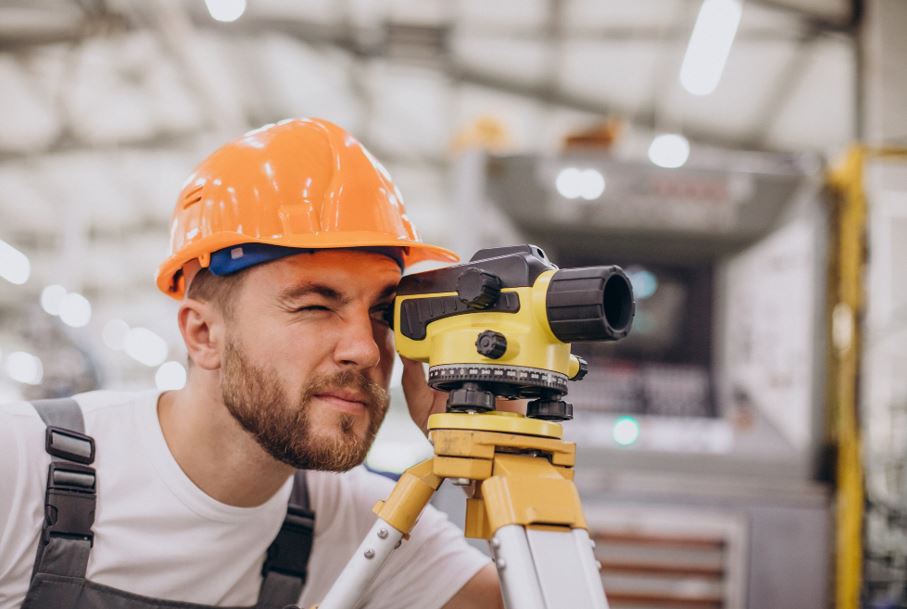
General land surveying requires crews to walk the entire property with GPS receivers and total stations to capture measurements point by point. For a five-acre site, this could take weeks of fieldwork depending on the site’s configurations and vegetation thickness. Why? The crew has to access each measurement point individually. It poses a problem in steep inclines, dense forests, and anywhere that is just too difficult to access.
The second problem? Weather postponement and accessibility challenges; they cannot travel where they can’t get access or where hazards may be present. For example, it’s easy to set up equipment on slight slopes, but on a steep incline, not so much.
LiDAR changes this game. A drone can cover that same five acres in an afternoon—maybe even less, and can take millions of data points without anyone needing to scramble through brush or hoist systems onto a slope.
Where Accuracy Actually Comes From
There’s an assumption that aerial mapping cannot match ground surveys for accuracy. While this made sense previously with photogrammetry systems, LiDAR systems counter this theory. First off, laser beams yield accurate measurements down to centimeters.
Second off, today’s LiDAR systems come with high-grade GPS and inertial measurement units that can tell LiDAR surveyors exactly where and how their systems operated at any given moment.
This is where accuracy comes at a cost for traditional methodologies, in order to get survey grade measurements across an entire site, one requires a lot of ground controls and point investigations. LiDAR systems can maintain general accuracy across an entire site without the need of control points every 100 feet or so.
LiDAR also penetrates vegetation better than people expect. LiDAR pulses can bounce through tree canopy leaves; some hit branches while some go all the way to the ground. Ground processing systems can filter out any returns that are associated with vegetation to focus on the actual ground surface, a virtually impossible feat for standard aerial photography.
What Gets Done With All This Data
It’s more than aesthetics of 3D models that come from this information. Engineers use LiDAR mapping for grading systems, cut-and-fill calculations for stumping out areas and stormwater drainage compliance considerations. LiDAR mapping can show subtle slopes and other site features that direct water flow direction, something crucial for stormwater management and erosion control.
Construction crews utilize LiDAR mapping for project management before their heavy equipment ever comes on site, understanding what they’re working with assists access plan logistics, project access road requirements and scope of work goals for site-clearing functionality. For example, if there’s more vegetation than anticipated because of insufficient survey information leading up to construction, change orders dictate new evaluation, which costs budget and time.
Environmental consultants use LiDAR for watershed assessments, habitat assessments and before/after project work assessments. Solar developers need accurate topographical measurements for panel placement and shading considerations while cell tower companies utilize LiDAR for line-of-sight distance assessment from towers to large radius coverage areas. If the data makes sense, it can be used across industries, applications evolve with emerging needs too!
The Practical Side Nobody Mentions
What’s rarely discussed is the amount of time it saves on turnaround time, as well as getting accurate information sooner rather than later. Traditional surveys could take weeks or even months in the field alone before processing time assesses the data through drafting efforts.
LiDAR can collect data in days (or hours) depending on site size with even preliminary results assessing the information processed within a week after collection. It helps projects move forward when feasibility assessments don’t determine possibilities based on out-of-date information because traditional surveyor crews have been in their working worlds for weeks/months instead of keeping data current through fast assessment means.
Cost comparison is hard but if time is money, LiDAR wins easily since it captures tons more data than trying to get spot checks across miles, combined with more brush-clearing abilities from aerial perspectives eliminating difficult terrains or inaccessible parts of sites altogether means comprehensive coverage.
Why This Technology Stuck Around
LiDAR mapping has gone from experimental technology to standard processes because it solves real-world problems for project managers who require terrain data faster than what conventional technologies provide.
Technology makes it possible without sacrificing quality, decision makers aren’t going to go forward with questionable accuracy; engineering and construction decisions require the best possible final product. For land development professionals moving forward, terrain data simplified through 21st-century options makes sense why LiDAR is the critical discussion.
Featured image : freepik.com
