
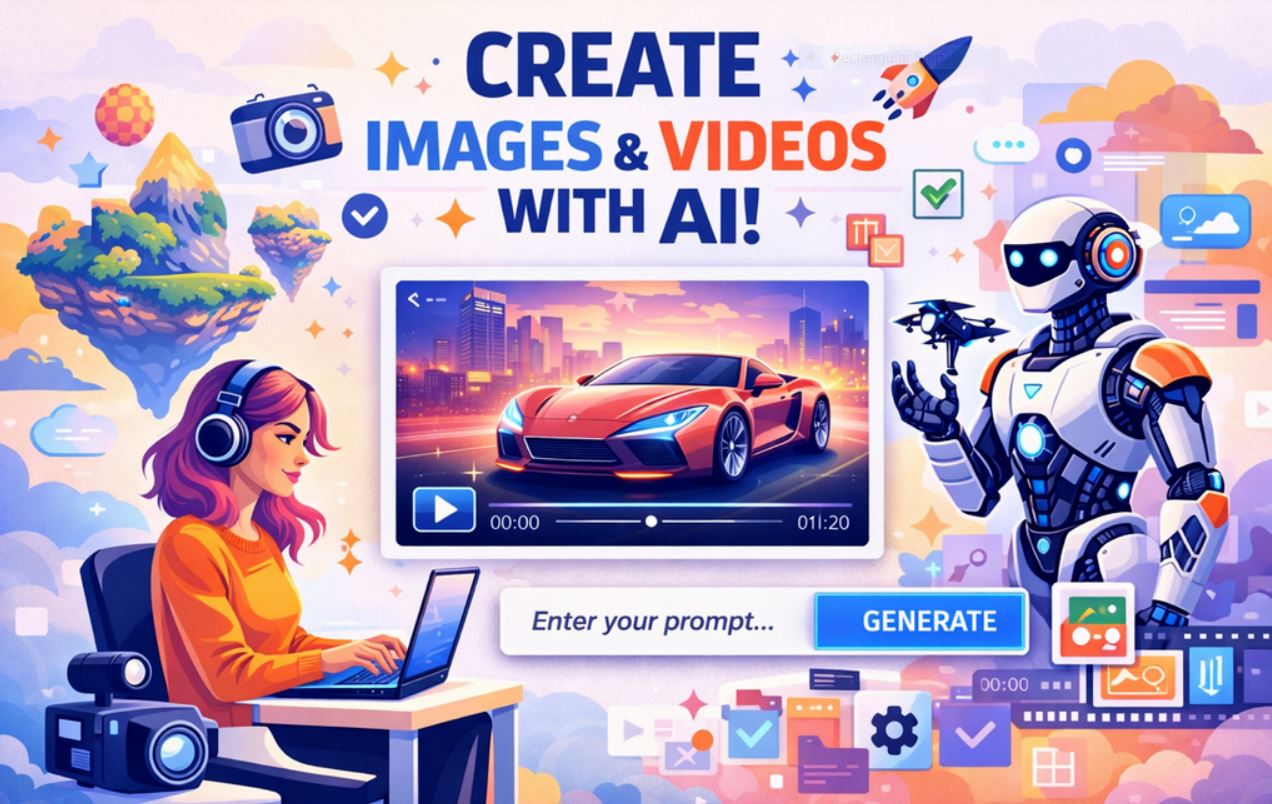
The history of visual art has always been a history of barriers. From the fresco painters of the Renaissance who spent decades mastering the chemistry of pigments to the 20th-century cinematographers who lugged massive reels of celluloid across deserts, the distance between a human thought and its physical manifestation was once measured in years of grueling apprenticeship and millions of dollars in equipment. For the longest time, the creative industry was a fortress. If you didn’t have the technical keys—mastery over complex software, a deep understanding of light physics, or a massive production budget—your ideas remained locked inside your mind.
However, we are currently witnessing the collapse of that fortress. The architectural foundations of visual expression are undergoing a seismic reconstruction, driven by the emergence of sophisticated artificial intelligence. We are moving away from a world of “static” creation toward one of “cinematic” fluidity. This transition represents more than just a technological upgrade; it is a fundamental shift in the democratization of human imagination. Today, the “walled garden” of professional design is being replaced by an open playground where the only true currency is the quality of your vision.
The Great Democratization: From Technical Mastery to Creative Curation
The most profound impact of AI in the visual arts is the destruction of the “technical gatekeeper.” In the traditional workflow, a creator spent 90% of their time on execution and only 10% on ideation. You had to navigate the labyrinthine menus of professional editing suites, manually mask out backgrounds, and spend hours keyframing the movement of a single shadow.
Artificial intelligence has flipped this ratio on its head. By automating the mechanical aspects of creation, AI allows the user to step into the role of a “Creative Director” rather than a “Production Technician.” The rise of text-to-image and image-to-video technologies means that the speed of thought is finally beginning to match the speed of production. We are no longer limited by what our hands can draw, but by what our minds can conceive.
This accessibility is revolutionary for the “outsider” creator. Whether it is a small business owner in a remote town or a student with a cheap laptop, high-fidelity visual storytelling is now within reach. The democratization of these tools means that a brilliant idea no longer needs a Hollywood budget to look like a Hollywood production.
The Intelligent Canvas: Redefining the AI Image Editor
When we discuss AI in the context of images, the conversation often lingers on the initial “spark”—the prompt that generates an image from nothingness. While that is undeniably impressive, the true workhorse of the modern creative era is the Advanced AI Image Editor. This is not the basic photo-tuning software of yesteryear; it is an intelligent partner capable of semantic understanding.
A traditional editor sees pixels; an AI editor sees objects. It understands that a “tree” has texture, that “water” should reflect the sky, and that “light” should wrap around the curves of a human face. This allows for a level of manipulation that was previously the stuff of science fiction. If you provide a rudimentary sketch—a few lines representing a landscape—the AI doesn’t just “fill in the blanks.” It interprets your intent, applying depth, atmosphere, and photorealistic lighting to transform a doodle into a masterpiece.
Furthermore, the “professional polish” that used to take days of color grading and retouching can now be achieved in seconds. Want to change the mood of a scene from a sunny afternoon to a moody, rain-soaked noir? In the past, this required complex masking and color-correction layers. Now, it is a simple matter of re-lighting the scene through AI. This bridge between raw generation and surgical refinement is what allows creators to move from “generic AI art” to “bespoke professional assets.”
Temporal Alchemy: The Evolution of AI Video Generation
If AI image generation was the first tremor of this revolution, AI video generation is the earthquake. Video has always been the most difficult medium to master because it requires a mastery of time. To create a moving image, you must understand how light changes over seconds, how fabric folds during movement, and how a camera lens behaves as it pans across a room.
The emergence of “AI video from image” technology is nothing short of temporal alchemy. It allows us to take a singular, frozen moment in time—a static photograph or a generated artwork—and breathe a soul into it. These AI models possess an internal understanding of physics. When you ask an AI Video Generator to animate a still image of a waterfall, it doesn’t just warp the pixels; it simulates the flow of water, the mist rising from the bottom, and the way light refracts through the droplets.
For the modern content creator, this is a superpower. In the attention economy of social media, static images are often ignored, while video commands engagement. By using an AI video maker, a creator can transform their entire portfolio of still assets into a dynamic library of cinematic clips. This eliminates the need for expensive film crews or complex 3D animation software. We are reaching a point where a single artist can produce a cinematic teaser, a music video, or a promotional campaign that possesses the visual density of a big-studio production.
Practical Applications: The New Creative Workflow
The utility of these tools is best observed through the lens of real-world application. How are people actually using this “magic” to solve problems?
- The Narrative Architect (The Digital Artist): Consider the concept artist working on a new video game. Instead of spending a week painting one environment, they can generate twenty different iterations of a “cyberpunk cityscape” in minutes. They then use the AI Image Editor to combine the best elements of each, effectively using AI as a “supercharged mood board” that accelerates the journey from concept to final render.
- The Agile Brand-Builder (The Marketer): A marketing team has a limited budget for a new product launch. Instead of a multi-day photo shoot, they take one high-quality product shot. Using AI, they generate diverse backgrounds—one in a luxury apartment, one in a mountain cabin, one in an abstract studio. They then use an AI Video Generator to turn these into “scroll-stopping” social media ads. One asset becomes a hundred unique pieces of content.
- The Solo Visionary (The Content Creator): For YouTubers or streamers, branding is everything. An AI-powered suite allows them to create high-drama thumbnails and animated intros that look like they were designed by a professional agency. This professionalization of the “bedroom creator” is perhaps the most visible sign of the AI shift.
- The Local Entrepreneur: A local bakery owner can take a simple smartphone photo of a croissant and, through AI, place it on a marble countertop under professional studio lighting, creating a high-end advertisement for a fraction of the cost of a professional photographer.
The Power of Integration: The All-in-One Solution
As the market for AI matures, we are seeing a shift away from fragmented, “single-use” tools toward integrated platforms. The early days of AI were characterized by “tool fatigue”—having one website for generating text, another for images, and a third for video. This friction killed the creative flow.
The future belongs to the “all-in-one” ecosystem. When generation, editing, and animation live under one roof, the workflow becomes a seamless loop. You generate an image, refine it in the editor, and animate it in the video engine without ever leaving your creative “zone.” This integration also solves the problem of stylistic consistency; the AI understands the aesthetic you are building across different formats.
Furthermore, these platforms are lowering the financial barrier. By offering daily credits and free-to-access tiers, they provide a “sandbox” for experimentation. This allows users to fail, iterate, and learn without the looming pressure of a massive subscription fee. The inclusion of automatic cloud storage ensures that a creator’s digital library is always at their fingertips, ready to be repurposed for the next project.
Closing Reflections: The Renaissance of the Idea
We are not just using better tools; we are entering a new phase of human expression. For decades, the technical “how” was so difficult that it often overshadowed the creative “why.” People didn’t make movies because it was too hard; people didn’t paint because they “couldn’t draw a straight line.”
AI image and video tools are removing those excuses. They are taking the technical heavy lifting—the rendering, the physics, the rotoscoping—and handling it in the background. This leaves the human creator with the most important task of all: storytelling.
The transition from static to cinematic is about more than just moving pictures; it is about moving the human spirit. Whether you are a professional designer looking to optimize your output or a hobbyist looking to explore the boundaries of your imagination, the tools of the future are here, and they are more accessible than ever. The barrier is gone. The gate is open. The only question left is: What story will you tell?
