
The Information Overload Dilemma In the twenty-first century, we are no longer suffering from a lack of information, but from an overwhelming abundance of it. Every minute, hours of video content are uploaded to YouTube, thousands of academic papers are published, and countless articles flood the web. For students, researchers, and professionals, the challenge has shifted from finding information to processing it effectively. How can one extract the “signal” from the “noise” without spending dozens of hours in front of a screen?
Enter Lynote.ai, an all-in-one AI-driven learning assistant designed to bridge the gap between massive data consumption and genuine understanding. By leveraging advanced natural language processing, Lynote is transforming how we interact with digital content, turning passive consumption into an active, efficient learning experience.
Bridging the Gap Between Video and Text One of the most significant shifts in modern education is the rise of video-based learning. While platforms like YouTube offer a goldmine of tutorials and lectures, they are inherently difficult to scan or reference. Unlike a textbook, you cannot “skim” a 45-minute video to find a specific key point easily.
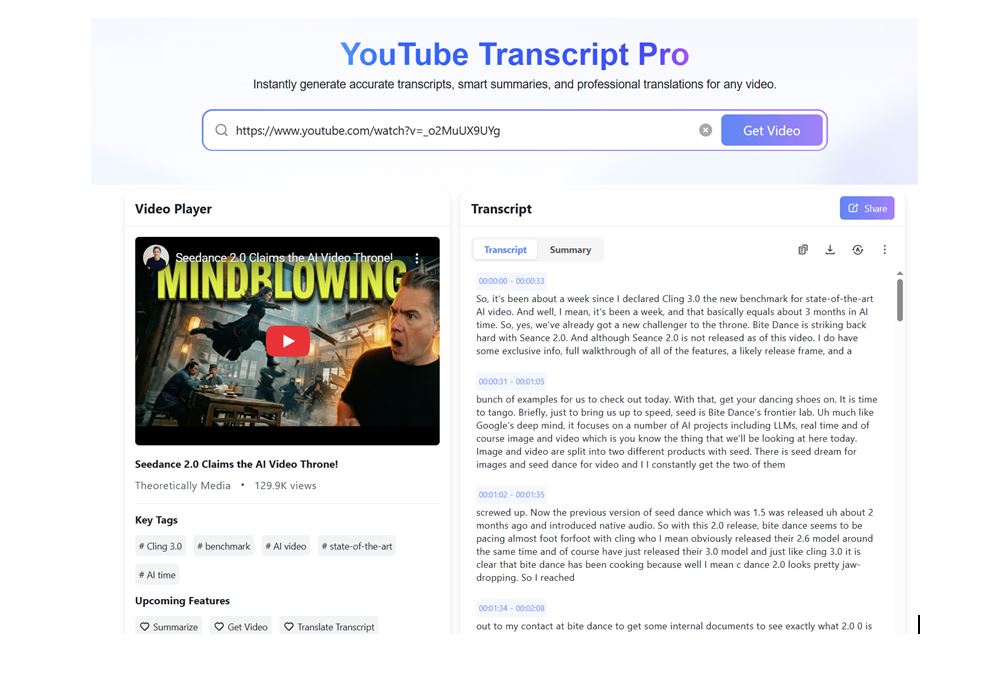
Lynote addresses this pain point through its sophisticated YouTube Transcript Generator and Video Summarizer. By converting spoken words into structured text and concise summaries, it allows users to digest the core message of a lecture in minutes rather than hours. This is not just a convenience; it is a fundamental shift in cognitive efficiency. For a university student preparing for finals or a consultant researching a new market, the ability to “read” a video saves invaluable time.
The Integrity of Information: Detection and Humanization As Generative AI becomes mainstream, a new challenge has emerged: maintaining the integrity and authenticity of written work. Educators are concerned about academic honesty, while publishers and SEO specialists are navigating the complexities of AI-generated content.
Lynote tackles this head-on with its dual-purpose toolkit: the AI Detector and the AI Humanizer. The AI Detector provides a high-accuracy analysis of text to identify machine-generated patterns, helping educators uphold academic standards. Conversely, the AI Humanizer is designed for creators who use AI as a drafting tool but want to ensure their final output resonates with human nuance and avoids the “robotic” tone that often triggers filters. This balance ensures that AI is used as a collaborator rather than a replacement for human thought.
Deep Research Made Simple Beyond simple summaries, the true power of an AI assistant lies in its ability to handle complex documents. Many professionals deal with dense PDFs, legal contracts, or technical manuals daily. Lynote’s upcoming Research Assistant and Knowledge Hub features aim to create a “central source of truth.”
Imagine uploading a 100-page industry report and being able to “ask” the document questions. “What are the three main financial risks mentioned in chapter 4?” or “Summarize the methodology used in this study.” By providing instant answers grounded in the provided text, Lynote eliminates the need for manual searching, allowing users to focus on high-level strategy and critical thinking.
Personalized Learning and Productivity The platform is not just for professionals; it is a “Study Partner” for lifelong learners. One of the most effective ways to retain knowledge is through active recall and repetition. Lynote’s integration of flashcards and practice tests—automatically generated from your own notes—transforms a static summary into a dynamic study tool.
This personalized approach aligns with the “10x Efficiency” promise. When the friction of note-taking and organizing is removed, the brain is free to focus on synthesis and application. Whether you are a researcher conducting a literature review or a hobbyist learning a new language through podcasts, the platform adapts to your specific workflow.
The Future of Learning with Lynote As we move toward a more AI-integrated society, the goal of tools like Lynote.ai is not to replace the human mind, but to augment it. By automating the mechanical tasks of transcribing, summarizing, and detecting, we are left with more time for what humans do best: innovating, creating, and solving complex problems.
The digital age demands a new set of tools for a new way of working. Lynote is not just another AI app; it is a comprehensive ecosystem for anyone who values their time and their growth. In a world where knowledge is power, the ability to learn faster and more accurately is the ultimate competitive advantage.
Conclusion As we look toward the future of education and professional development, the integration of AI is inevitable. Platforms like Lynote.ai represent the vanguard of this movement—empowering users to stop drowning in information and start truly understanding it. For those ready to boost their learning efficiency and reclaim their time, the era of “smart learning” has officially arrived.
