
Introduction
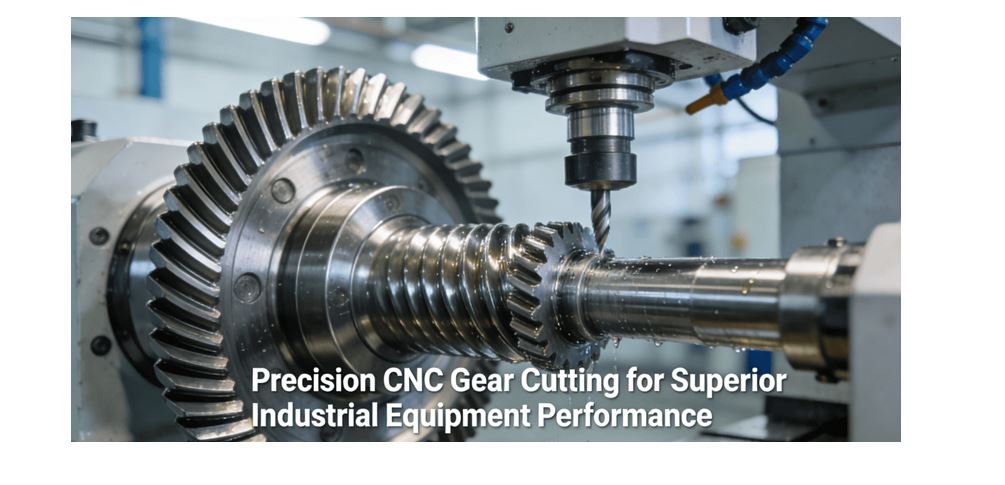
In industrial equipment design, gear cutting plays an important role in the performance and efficacy of the machine. Conventional procedures for gear cutting may experience difficulties in precision and time constraints. This may lead to the generation of noise levels and a reduction in the lifespan of the equipment. This problem may arise due to the absence of precision in conventional gear cutting processes. Selecting the wrong service supplier may be an added disadvantage. This article will provide information on the best practices of CNC Gear Cutting Services.
What are the key advantages of CNC gear cutting services?
CNC Gear Cutting Services utilize computer-controlled equipment to achieve exceptional accuracy and repeatability in producing Precision Manufacturing Parts. The digital control of tool paths eliminates inconsistencies inherent in manual operations, ensuring each gear meets exact design specifications .
Industry standards, such as those by the American Gear Manufacturers Association (AGMA), link gear precision to performance metrics like load capacity and service life. Advanced CNC Machining Services consistently achieve high AGMA grades (e.g., 10–12), resulting in longer gear life, smoother operation, and reduced noise and vibration . This precision is crucial in industrial equipment design, where flaws in transmission components can cause systemic failures. Unlike traditional methods, CNC technology maintains micron-level accuracy across large production runs. For high-volume production of helical gears, Gear Cutting Services like gear hobbing offer an efficient solution, balancing speed and accuracy .
How to choose a reliable gear hobbing service provider?
Selecting a competent provider for gear hobbing services is vital for projects involving Custom Part Fabrication. Key factors include technical capability, quality certifications, and strategic evaluation of local versus global suppliers.
Technical Capability and Quality Assurance
Providers must possess modern CNC hobbing machines, gear measuring centers, and metrology equipment to verify part dimensions and tooth geometry accurately . Compliance with international standards like ISO 9001 and AS9100D demonstrates a commitment to quality management, ensuring controlled processes from material procurement to final inspection .
- Material Compatibility and Secondary Processing
Gear performance depends on material properties and secondary treatments. Reliable providers offer expertise in diverse materials (e.g., steels, brass, aluminum) and essential services like heat treatment (quenching, carburizing) to enhance durability .
- Precision and Tolerance Standards
The ability to maintain tight tolerances (e.g., ±0.02 mm) is critical. Suppliers should provide sample inspections or case studies verifying AGMA or ISO accuracy grades .
Strategic Evaluation: Local vs. Global Suppliers
Local suppliers (found via “gear hobbing services near me“) offer easier communication and faster logistics for small-batch urgent needs. However, global specialists often provide advanced technology, broader material options, and greater experience with complex projects, offering better long-term value for large-volume production . A detailed guide on selecting the best CNC Gear Cutting Services can assist in this process .
How do CNC gear grinding services enhance industrial equipment performance?
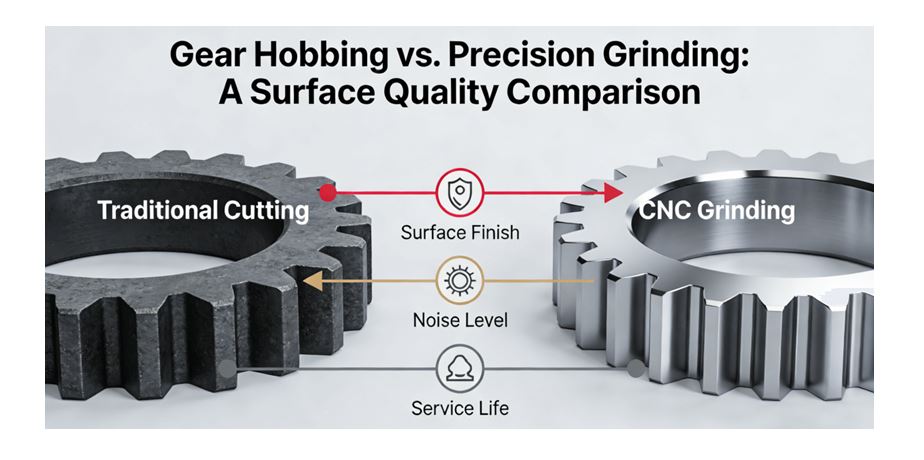
For the highest precision and surface quality, CNC gear grinding services are ideal. This process corrects distortions from heat treatment, achieving exceptional tooth profile accuracy and surface finish, which is crucial for Industrial Equipment Design .
Mechanisms of Performance Enhancement
The process produces superior gear surface finishes and precise tooth flanks, ensuring optimal meshing under high loads and speeds. This reduces noise, wear, and resistance to pitting. AGMA studies indicate that grinding improves surface integrity, increasing load capacity and extending service life .
Application-Specific Advantages
These services excel in applications demanding extreme precision and durability, such as aerospace, robotics, and automotive transmissions.
- Aerospace and High-Performance Robotics
In aerospace and robotics, components endure extreme stress and temperature variations. CNC gear grinding achieves tight tolerances (e.g., AGMA 12–13), corrects heat treatment distortions in high-strength materials, and ensures dimensional stability under dynamic loads, enhancing safety and accuracy .
- Automotive and Industrial Transmissions
For automotive and heavy industrial equipment, grinding reduces operational noise and improves power transmission efficiency. Superior surface finishes (e.g., <0.5 μm Ra) minimize friction and heat, extending gear life in high-torque applications like electric vehicle drivetrains and wind turbine gearboxes .
What are common mistakes in gear cutting and how to avoid them?
Common pitfalls include inadequate design-for-manufacturability (DFM) analysis and incorrect process selection. Engaging manufacturing engineers early optimizes parameters like root fillets and tolerances, avoiding cost overruns . Choosing grinding for gears that only need hobbing increases costs, while under-specifying for high-performance applications leads to failure. Selection should be based on operational requirements (load, speed, noise) .
Neglecting supplier quality control is risky; partners must provide inspection reports and have robust processes. Using Rapid Prototyping Solutions for testing validates designs before full-scale production, preventing batch failures. For complex projects, full-service providers offering Gear manufacturing services are beneficial .
Future trends: How will CNC gear cutting adapt to smart manufacturing?
The future of CNC Gear Cutting is linked to Industry 4.0, with trends like automation and digitalization redefining efficiency. Automated cells with robotics enable “lights-out” production, increasing output . Digital integration allows seamless data flow from CAD to CNC, minimizing errors. IoT sensors monitor machine health and tool wear, enabling predictive maintenance and dynamic optimization .
This supports high-mix, low-volume production through Flexible Manufacturing Systems (FMS). Combined with Rapid Prototyping Solutions, this agility speeds development cycles. Providers with strong digital capabilities, such as JS Precision, are well-positioned to leverage these trends for Industrial Equipment Design .
Conclusion
Such analysis underlines the benefits of CNC Gear Cutting Services, criteria for choosing responsible partners, and ways to bypass all widely spread mistakes. The adoption of advanced technologies of CNC and international standards significantly improves equipment performance, reliability, and cost-effectiveness.
Check out dedicated gear machining services to get a custom solution, or download a free technical guide to inform and optimize design and manufacturing processes.
Author Biography
The author is an independent expert in precision manufacturing, with extensive experience in industrial equipment design and CNC technology application. This article is based on objective industry analysis for engineering and procurement professionals.
FAQs
Q: What is normally lead time when it comes to CNC gear cutting services?
A: Lead times can also vary depending on the complexity associated with the gears, as well as the production methods used (hobbing versus grinding), as well as order quantities. Low-complexity projects can typically be completed within 1-2 weeks. However, high-precision orders that include heat treatment can take as long as 6-8 weeks.
Q: What is the method whereby gear cutting precision is assured to be within standards?
A: Precision will be achieved through the choice of supplier with the necessary quality standards (e.g., ISO 9001) and the availability of up-to-date measurement tools such as gear measurement centers. Asking for the results of an inspection report that confirms AGMA and ISO accuracy grades is common for quality assurance.
Q: Is gear hobbing a service suitable for small batch production?
A: Yes, the latest CNC hobbing machines can easily adapt to batch production because of malleable programming and set-ups. Yet, it may prove costly on a per-piece basis compared to batch production. For the first prototype creation or small-scale productions, it will prove economical to first start with CNC Milling –Rapid Prototyping Solutions.
Q: What is the primary benefit obtained from gear grinding services?
A: The main benefit is that it is capable of achieving the best possible accuracy for a tooth profile and surface finish on hardened gears. This is particularly important, especially when it comes to noise reduction, increased load-carrying capacity, and overall life.
Q: What are the tips for finding a good gear cutting service?
A: Looking for “gear hobbing services near me” might help one in identifying an option in the vicinity, but it is imperatively necessary to check their technology capabilities and certifications in advanced gear hobbing techniques, and in some instances, worldwide companies might be a better option compared to options in the vicinity.
