
Back in 2020, if you wanted to hedge a perpetual position in both directions on a mid-tier exchange, you simply couldn’t. Traders needing bi-directional exposure had to open accounts on two separate platforms, manually shuffling collateral between them. By late 2024, bi-directional hedging and shared-margin pools shipped as standard toggles on platforms that had rebuilt their matching engines from scratch. As of April 2026, one such platform — BYDFi — is celebrating its 6th anniversary with a month-long campaign and a prize pool exceeding $1,000,000.
That gap — between what a trading interface casually offers today and what was physically impossible five years ago — is the real story. The evolution of crypto trading platforms has been less about front-end polish and more about unseen back-end rebuilds.
The Infrastructure Nobody Saw (2020–2022)
According to CoinGecko’s exchange tracker, over 400 crypto exchanges were listed in 2020. More than half subsequently shut down, got hacked, or faced enforcement actions within three years — including FTX in 2022 and Hotbit’s closure in 2023.
What separated survivors from casualties was back-end architecture: asset segregation, multi-party approval workflows, cold-storage ratios, and building compliance infrastructure before regulators forced the issue.
BYDFi’s timeline illustrates how product roadmaps tracked market demand. Founded in April 2020, the platform scaled to 500+ spot pairs by May 2021, then layered on perpetual contracts — 150+ pairs with leverage up to 200x, a level carrying extreme liquidation risk and restricted in several jurisdictions including the UK and EU. The sequencing matters: spot depth first, derivatives second. Bybit and Bitget followed similar patterns, suggesting an industry-wide approach. By early 2026, the platform offered 1,000+ spot pairs, 500+ perpetual contracts, automation tools like grid bots and DCA strategies, support for 100+ fiat currencies, on-chain trading via its MoonX engine, and claimed >1:1 Proof of Reserves since October 2024.
The Real Inflection Point
The popular narrative says regulatory crackdowns after FTX drove the technology inflection. Partially true. But the deeper shift was transparency infrastructure becoming a competitive requirement. Binance, OKX, and Bitget all began publishing proof-of-reserve data following FTX’s collapse — an industry-wide reckoning with custody transparency.
BYDFi states it began publishing Proof of Reserve reports showing greater than 1:1 asset backing in October 2024. The methodology should be reviewed directly on the platform’s transparency page. The following month, the exchange joined Korea’s CODE VASP Alliance and filed U.S. MSB registrations with FinCEN. Worth clarifying: MSB registration is a reporting obligation, not a regulatory license — it doesn’t provide the same consumer protections as securities regulation.
Here’s the uncomfortable truth: Proof of Reserves is necessary but not sufficient. It doesn’t guarantee operational solvency, code-level security, or counterparty risk in derivatives. According to Investopedia’s exchange explainer, evaluating an exchange requires assessing multiple risk dimensions simultaneously.
The Dual-Engine Bet
In April 2025, BYDFi launched MoonX — its Web3 on-chain trading engine supporting Solana, BNB Chain, and Base, creating a “CEX + DEX dual-engine” architecture. OKX launched its own integrated DEX aggregator around the same period — a clear pattern as platforms race to unify centralized and decentralized execution.
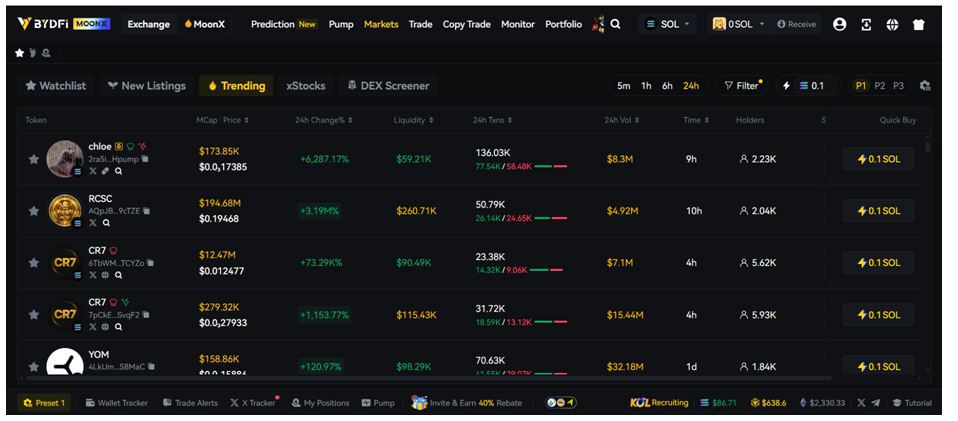
One account, two execution environments. Switching between the CEX order book and MoonX feels relatively seamless, though on-chain latency introduces noticeable differences in fill times. MoonX surfaces safety indicators for tokens — useful but not a substitute for independent contract audits.
Closing Perspective
Six years ago, a crypto trading platform was an order book with a login page. Today, the category encompasses perpetual engines with multiple margin modes, on-chain execution layers, synthetic traditional asset modules, automated strategy marketplaces, and hardware wallet integrations. The trajectory of platforms like BYDFi — from spot-only in 2020 to dual-engine architecture spanning derivatives, on-chain trading, and synthetic assets — illustrates how measurable that evolution has been.
But significant gaps remain in transparency, risk communication, and the tension between accessibility and security. No exchange has fully bridged the trust gap between centralized custody and verifiable on-chain self-sovereignty — dual-engine architectures represent an attempt, not a completed solution. The crypto fear and greed index reminds us that no platform architecture insulates traders from poor risk management. As CoinDesk has reported, leveraged crypto trading amplifies both gains and losses. The platforms worth watching are the ones still iterating on unsolved problems, not declaring victory.
Disclaimer: This article is for informational purposes only and does not constitute financial advice. Leveraged trading carries significant capital-loss risk.
