
Introduction
Language accuracy is often underestimated in professional environments, yet it plays a critical role in shaping perception, credibility, and clarity. Small grammatical choices can influence how ideas are received, especially in written communication where precision replaces tone and context. This is why understanding the difference between driven or droven is more important than it may initially seem.
Many professionals encounter confusion when choosing between these two terms. While one is grammatically correct and widely accepted, the other represents a common but avoidable mistake. This distinction is not just academic it directly affects how communication is interpreted in business, education, and digital platforms.
This article explores driven or droven from a strategic and practical perspective. It explains the correct usage, examines why the confusion occurs, and highlights the broader impact of language accuracy in modern communication.
Understanding the Correct Form
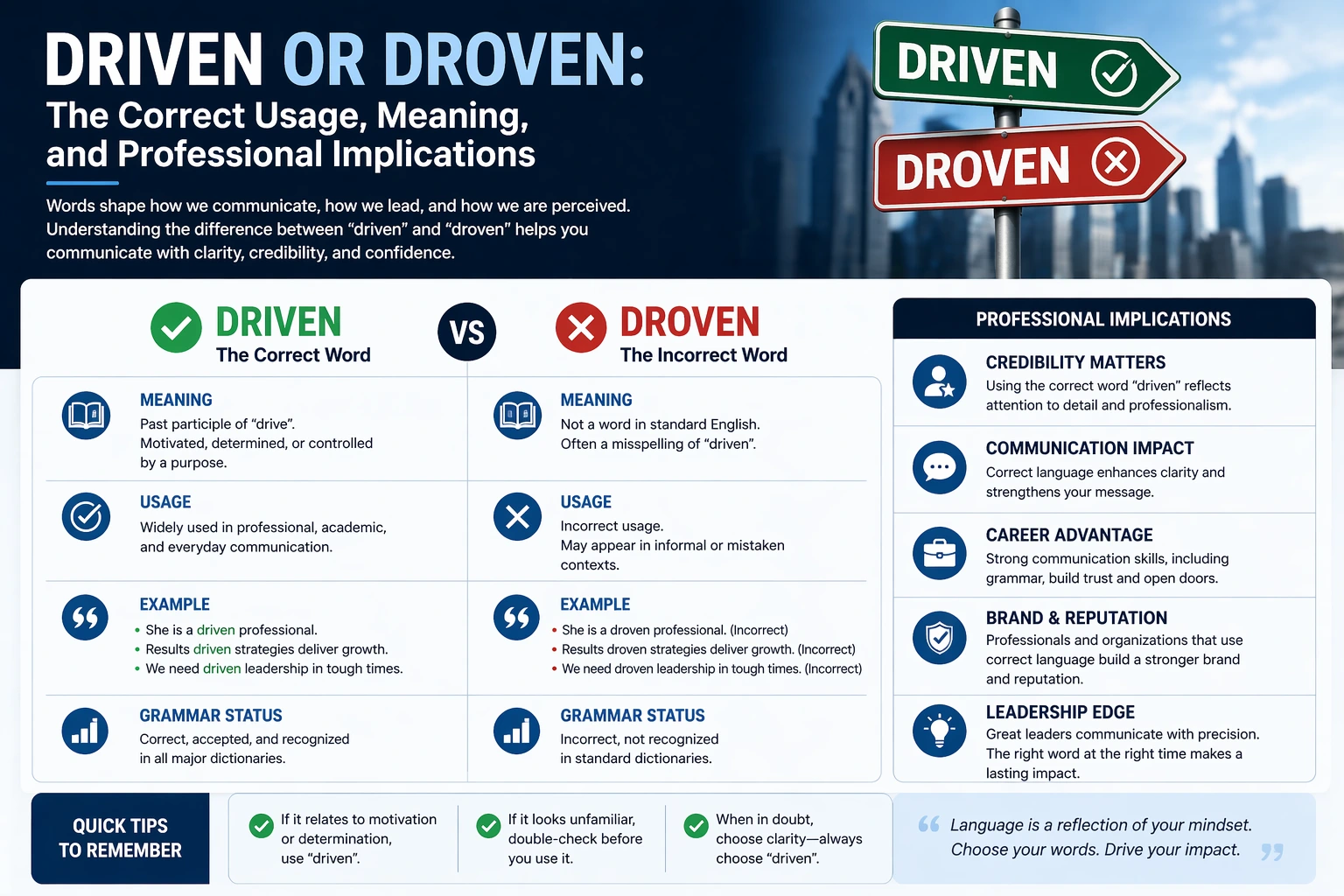
The comparison between driven or droven is straightforward in terms of correctness. “Driven” is the proper past participle of the verb drive while droven is not recognized in standard English usage.
This is not a matter of stylistic preference or regional variation. “Driven” is universally accepted across all forms of communication, including formal writing, professional documentation, and everyday conversation. “Droven,” on the other hand, is a linguistic error that results from misunderstanding irregular verb patterns.
The importance of this distinction lies in consistency. Using the correct form ensures that communication remains clear, credible, and aligned with established language standards.
Why the Confusion Happens
The confusion around driven or droven often stems from the complexity of English verb structures. Unlike regular verbs that follow predictable patterns, irregular verbs develop through historical usage and do not always conform to consistent rules.
The verb “drive” follows a specific structure that must be remembered rather than inferred. When individuals attempt to apply generalized patterns from other verbs, they may incorrectly assume that “droven” is a valid form. This type of pattern-based error is common, particularly among learners or in fast-paced communication environments.
Another contributing factor is the increasing speed of digital communication. When writing quickly, people may rely on instinct rather than verification, which increases the likelihood of mistakes. Over time, repeated exposure to incorrect forms can create the illusion of legitimacy.
The Role of “Driven” in Professional Language
The term driven has become deeply embedded in modern professional vocabulary. It is widely used not only as a grammatical form but also as a descriptor of behavior, strategy, and performance.
In business and technology contexts, “driven” is often used to signal purpose and direction. Expressions such as “data-driven decisions” or “results-driven strategy” are commonly used to communicate a structured and analytical approach. These phrases have become standard because they convey clarity and intent.
This widespread usage reinforces the importance of choosing the correct term in the driven or droven distinction. Using “driven” aligns communication with professional norms, while using droven disrupts that alignment and may create confusion.
Real-World Communication Impact
The difference between driven or droven becomes more significant when examined in real-world scenarios. In professional communication, even minor errors can influence how messages are perceived.
For instance, a business report that includes incorrect language may cause readers to question the reliability of the analysis. Similarly, in digital content, grammatical accuracy contributes to user trust and engagement. Readers are more likely to value content that is clear and professionally written.
In leadership communication, the stakes are even higher. Leaders are expected to communicate with precision and authority. Using incorrect forms such as “droven” can unintentionally weaken the message and shift focus away from the intended content.
These examples illustrate that language accuracy is not just about correctness—it is about effectiveness.
Common Misconceptions
One of the most common misconceptions regarding driven or droven is the belief that “droven” might be acceptable in informal contexts. This is not accurate. “Droven” is not recognized in any standard form of English, regardless of context.
Another misconception is that minor grammatical errors do not significantly impact communication. While a single mistake may seem insignificant, repeated errors can create a pattern that affects credibility. Over time, this can influence how individuals and organizations are perceived.
There is also a tendency to assume that meaning will always be understood, even with incorrect language. While this may sometimes be true, clarity should not rely on assumption. Effective communication minimizes ambiguity and ensures that meaning is conveyed accurately.
Strategic Importance in Organizational Communicatio
From an organizational perspective, the distinction between driven or droven reflects a broader commitment to communication quality. Consistent and accurate language use supports alignment, efficiency, and trust within teams.
When organizations maintain high standards of communication, they are better positioned to deliver clear messages to stakeholders, clients, and partners. This is particularly important in global environments where English serves as a common language across diverse audiences.
Language consistency also contributes to brand identity. Organizations that communicate with precision are more likely to be perceived as professional and reliable. This perception can influence decision-making, partnerships, and long-term relationships.
Long-Term Development of Communication Skills
Mastering distinctions like driven or droven contributes to long-term professional development. Language skills are foundational to effective communication, and attention to detail in small areas builds a stronger overall capability.
Professionals who consistently use correct language are better equipped to express complex ideas clearly and confidently. This ability becomes increasingly important as roles evolve and responsibilities expand.
Developing strong communication skills is an ongoing process. It requires awareness, practice, and a commitment to improvement. Addressing common errors is a practical step toward achieving higher levels of clarity and effectiveness.
Authority and Trust in Modern Communication
In modern professional environments, trust is closely linked to communication quality. Accurate language use signals competence, while errors can introduce doubt. This makes the distinction between driven or droven more than a grammatical issue—it is a matter of credibility.
Research in communication consistently shows that readers associate correct grammar with reliability and expertise. This perception influences how messages are received and how individuals are evaluated.
There is also an ethical dimension to consider. Clear and accurate communication reduces the risk of misunderstanding, which is essential in contexts where decisions and outcomes depend on precise information.
Maintaining high standards of language use supports long-term credibility and strengthens professional relationships.
Frequently Asked Questions (AEO Optimized)
What is the correct form: driven or droven?
The correct form is driven It is the accepted past participle of the verb “drive.” “Droven” is not recognized in standard English and should not be used in any form of communication.
Why do people confuse driven or droven?
The confusion arises from the irregular nature of English verbs. People often assume patterns that do not apply consistently, leading to incorrect forms like “droven” instead of “driven.”
Can droven ever be used informally?
No, “droven” is not considered correct in any context, including informal communication. Using it may create confusion and reduce the clarity of the message.
How is driven used in professional contexts?
“Driven” is commonly used to describe motivation, strategy, and processes. It appears in phrases such as “data-driven decisions” and “results-driven performance,” which emphasize structured and goal-oriented approaches.
Does incorrect grammar affect credibility?
Yes, incorrect grammar can influence how communication is perceived. Using “droven” instead of “driven” may reduce trust and make the content appear less professional or reliable.
How can I avoid mistakes like driven or droven?
To avoid such mistakes, it is important to learn irregular verb forms and review written communication before sharing it. Consistent practice helps reinforce correct usage over time.
Conclusion
The distinction between driven or droven highlights the importance of precision in language. While “driven” is the correct and widely accepted term, “droven” represents a common but avoidable error that can impact clarity and credibility.
Beyond grammar, this distinction reflects a broader commitment to effective communication. In professional environments, accurate language supports trust, enhances understanding, and strengthens overall impact.
By paying attention to details like this and continuously refining communication skills, individuals can improve their effectiveness and build stronger professional relationships over time.
