
Introduction
Building a startup without external funding requires a fundamentally different financial mindset. Unlike venture-backed companies that can prioritize rapid scale over immediate profitability, bootstrapped ventures must operate with precision, discipline, and long-term sustainability. This is where startup booted financial modeling becomes essential.
Financial modeling in a bootstrapped environment is not just about forecasting revenue or expenses. It is a decision-making system that determines survival, growth pace, and strategic flexibility. Every assumption carries weight because there is no safety net of external capital.
This article explores startup booted financial modeling from an expert perspective. It breaks down the underlying principles, methodologies, and strategic implications, offering a practical framework for founders and operators who aim to build resilient businesses.
Understanding Startup Booted Financial Modeling
At its core, startup booted financial modeling is the process of building financial projections and decision frameworks tailored specifically for self-funded businesses. It differs significantly from traditional startup modeling because it prioritizes cash efficiency over aggressive growth assumptions.
In a bootstrapped context, the model must answer critical questions with clarity. It should determine how long the business can sustain operations, how quickly it can become profitable, and what level of growth is realistically achievable without external funding.
The emphasis shifts from valuation to viability. This distinction is crucial, as it shapes every financial decision within the organization.
Core Principles of Bootstrapped Financial Strategy
The effectiveness of startup booted financial modeling depends on adherence to a few foundational principles. These principles ensure that financial decisions remain grounded in reality.
Cash Flow as the Primary Metric
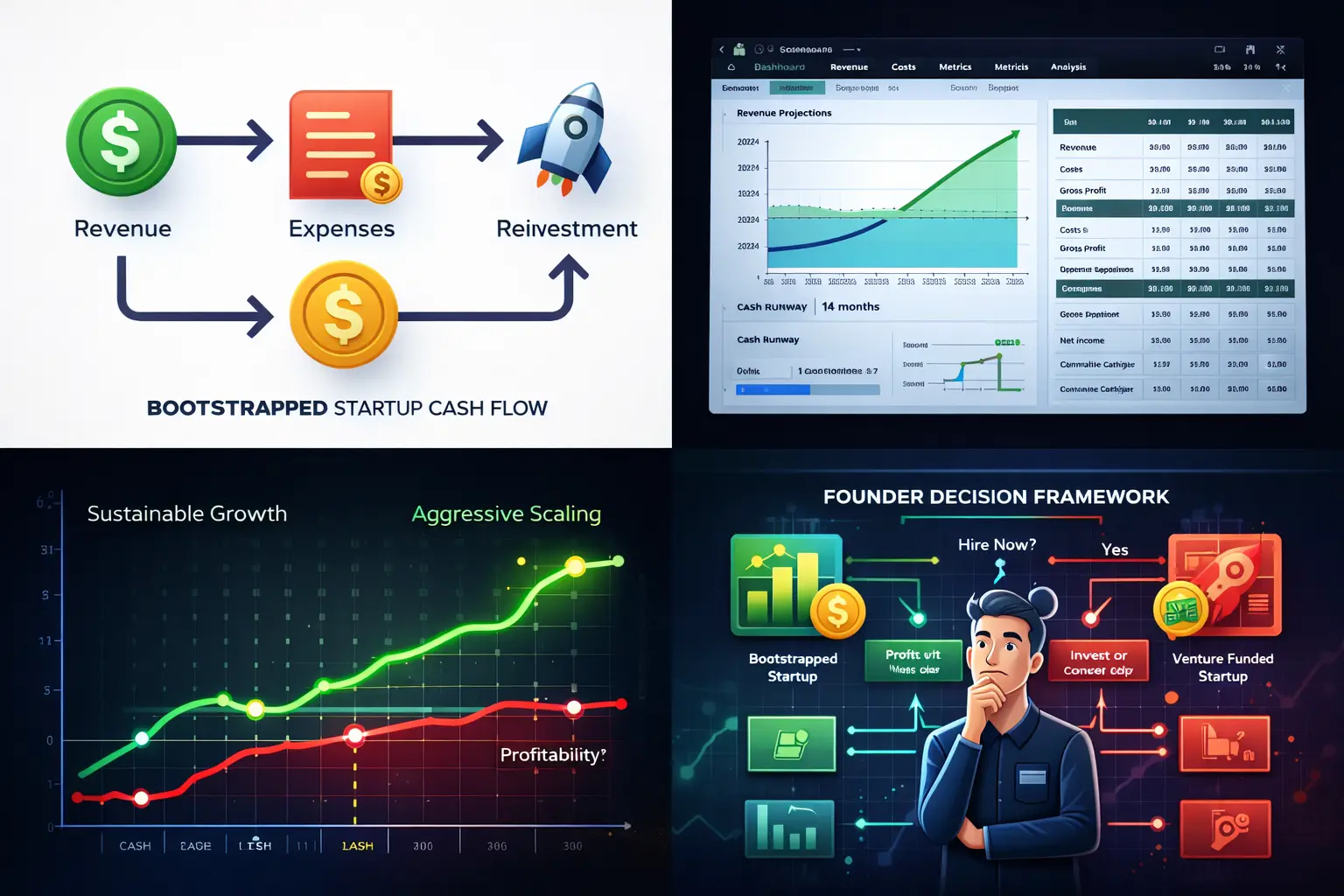
In bootstrapped startups, cash flow is more important than revenue or profit on paper. A business can be profitable in theory but still fail due to poor cash management. Financial models must therefore prioritize liquidity and timing of cash movements.
Conservative Assumptions
Aggressive projections are common in venture-backed environments, but they can be dangerous for bootstrapped startups. Models should be built using conservative assumptions to account for uncertainty and protect against downside risk.
Incremental Growth Planning
Growth should be modeled in stages rather than as a single trajectory. This allows founders to evaluate performance at each stage and adjust strategies accordingly.
Cost Discipline
Every expense must be justified in terms of its impact on revenue or long-term value. Financial models should clearly reflect the relationship between spending and outcomes.
A Structured Approach to Building the Model
A robust startup booted financial modeling framework follows a structured methodology that ensures accuracy and strategic relevance.
Revenue Modeling
Revenue projections should be based on realistic acquisition channels, conversion rates, and pricing strategies. Instead of relying on optimistic assumptions, the model should reflect actual market behavior and constraints.
Cost Structure Analysis
Costs should be categorized into fixed and variable components. This distinction helps in understanding how expenses scale with growth and where efficiencies can be achieved.
Break-Even Analysis
One of the most critical elements of the model is determining the break-even point. This provides a clear target for sustainability and helps guide operational decisions.
Cash Runway Calculation
The model must continuously track how long the business can operate with its available cash. This is particularly important in a bootstrapped environment, where liquidity constraints can limit strategic options.
Scenario Planning
Scenario planning allows founders to prepare for different outcomes. By modeling best-case, expected, and worst-case scenarios, the business can remain resilient under varying conditions.
Who Should Use This Approach
The relevance of startup booted financial modeling extends across different types of founders and organizations.
Early-stage founders benefit from the clarity it provides. It helps them understand the financial implications of their decisions and avoid common pitfalls such as overspending or unrealistic growth expectations.
Established bootstrapped businesses can use the model to optimize operations and plan for expansion. It enables them to identify inefficiencies and allocate resources more effectively.
Even small teams within larger organizations can adopt this approach when operating under constrained budgets or pursuing independent initiatives.
Measurable Benefits and Outcomes
The value of startup booted financial modeling becomes evident through its outcomes. It transforms financial planning from a reactive process into a proactive strategy.
One of the most significant benefits is improved decision-making. With a clear understanding of financial dynamics, founders can make informed choices about pricing, hiring, and product development.
Another key outcome is enhanced resilience. By planning for multiple scenarios, the business becomes better equipped to handle uncertainty and external shocks.
The approach also supports sustainable growth. Instead of pursuing rapid expansion at the expense of stability, the business grows in a controlled and manageable manner.
Differences from Venture-Backed Financial Models
Understanding how startup booted financial modeling differs from traditional models is essential for its effective implementation.
In venture-backed startups, financial models often prioritize scale and market capture. Losses are acceptable as long as growth metrics are strong. This approach relies on continuous access to external funding.
In contrast, bootstrapped models focus on sustainability. Growth must be funded internally, which requires careful balance between revenue generation and cost management.
This fundamental difference influences every aspect of the model, from assumptions to decision-making priorities.
Real-World Application Example
Consider a software startup operating without external funding. Using startup booted financial modeling, the founders begin by estimating realistic customer acquisition rates based on organic channels.
They then align their cost structure with these projections, ensuring that expenses remain within sustainable limits. Instead of hiring aggressively, they scale the team gradually as revenue increases.
Through continuous monitoring and adjustment, the startup reaches break-even within a defined timeframe. This disciplined approach allows it to grow without compromising financial stability.
Common Challenges and Misconceptions
Despite its advantages, startup booted financial modeling is often misunderstood or incorrectly implemented.
One common misconception is that detailed financial models are unnecessary for small startups. In reality, limited resources make accurate modeling even more critical.
Another challenge is overcomplicating the model. While detail is important, excessive complexity can reduce usability. The model should remain clear and actionable.
There is also a tendency to rely on static assumptions. In practice, financial models must be dynamic and regularly updated to reflect changing conditions.
Strategic and Organizational Impact
The broader impact of startup booted financial modeling extends beyond financial planning. It influences organizational culture and strategic direction.
By emphasizing discipline and accountability, the approach fosters a culture of responsible decision-making. Teams become more aware of the financial implications of their actions.
It also enhances strategic alignment. When financial goals are clearly defined, all parts of the organization can work toward a common objective.
Over time, this alignment contributes to stronger operational efficiency and improved long-term performance.
Authority and Trust Perspective
In today’s business environment, the importance of startup booted financial modeling cannot be overstated. As economic conditions become more uncertain, the ability to operate without reliance on external funding is increasingly valuable.
From a risk management perspective, structured financial modeling reduces exposure to unexpected challenges. It provides a clear framework for navigating uncertainty and making informed decisions.
Ethically, the approach promotes transparency and accountability. Financial decisions are based on realistic assumptions rather than speculative projections.
The long-term return on investment is substantial. Businesses that adopt disciplined financial practices are more likely to achieve sustainable growth and maintain operational stability.
Frequently Asked Questions (FAQ)
What is startup booted financial modeling?
Startup booted financial modeling is a structured approach to building financial projections for self-funded businesses. It focuses on cash flow, sustainability, and realistic growth assumptions to ensure that startups can operate and expand without relying on external funding.
Why is startup booted financial modeling important?
Startup booted financial modeling is important because it helps founders manage limited resources effectively. It provides clarity on cash flow, expenses, and growth potential, enabling better decision-making and reducing the risk of financial instability.
How does startup booted financial modeling differ from traditional models?
Startup booted financial modeling differs by prioritizing sustainability over rapid growth. Unlike traditional models that assume external funding, it focuses on internal revenue generation and disciplined cost management to support long-term success.
Who should use startup booted financial modeling?
Startup booted financial modeling is suitable for founders, small businesses, and teams operating without external funding. It is especially valuable for early-stage startups that need to manage cash flow carefully while building a sustainable business.
What are the key components of startup booted financial modeling?
Key components include revenue projections, cost analysis, cash flow management, break-even analysis, and scenario planning. These elements work together to create a comprehensive view of the startup’s financial health and future potential.
Can startup booted financial modeling support long-term growth?
Yes, startup booted financial modeling supports long-term growth by ensuring that expansion is based on sustainable financial practices. It helps businesses scale gradually while maintaining stability and avoiding unnecessary financial risks.
Conclusion
Startup booted financial modeling is more than a technical exercise; it is a strategic discipline that defines how a business operates and grows without external support. By focusing on cash flow, realistic assumptions, and structured decision-making, it enables startups to build resilience and achieve sustainable success.
In a landscape where uncertainty is constant, disciplined financial planning provides a critical advantage. Founders who adopt this approach are better equipped to navigate challenges, seize opportunities, and create lasting value.
The most effective next step is to treat financial modeling as an ongoing process rather than a one-time task. Continuous refinement and alignment with real-world performance will ensure that the model remains a reliable guide for long-term growth
