

Introduction
Poor selection of gear machining services is one of the primary causes of project delays, cost overruns, and defects in quality within the manufacturing industry. As a matter of fact, above 30% of projects, due to technical mismatches, record critical setbacks that dent efficiency in the supply chain and erode profitability. This, however, is attributed to conventional evaluation methods based on price rather than technical compatibility, leading to incorrect judgments about suppliers.
The given article develops a scientific framework, based on industry-specific applications, technical metrics, and accurate pricing to enable the engineer to optimize decision-making. The subsequent sections enumerate how this is accomplished.
What are the major industry-specific applications and the resultant technical demands for gear machining?
The processing requirements of gears vary greatly in different fields, each with its technical requirements, which make the choice of service different. Understanding these subtle differences is important in the viewpoint of expensive mistakes and to facilitate smooth integration into the more extensive manufacturing process.
1. Automotive Industry Precision and Noise Control Standards
The automobile industry requires precision gears, which have tight tolerance levels, like those defined under the DIN 6 standards, for seamless transmission. The required materials are alloy steel, which is more robust, along with other factors like noise suppression at or below 65 dB, which helps improve passenger comfort. Engineers must focus more on manufacturers who have the required standards.
2. Aerospace Applications for High Stress and Lightweight Components
Aerospace gear machining needs parts that can resist high stresses with reduced weight. The processing conditions entail the use of special materials, for instance, titanium alloy or composite, with precise tolerance being a parameter in safety-critical applications. The quality metrics would, therefore, include fatigue life and reduced backlash, requiring compliance with AS9100D. It is important to follow the standard for geometric dimensioning and assembly as set by ASME Y14.5, ensuring consistency in compliance for complex parts. The designer can consult a gear machining service selection guide to conforming to this demand.
3. Industrial Machinery and Robustness Under Heavy Loads
The gears in industrial machinery have to bear heavy loads and work uninterruptedly; therefore, the emphasis is on their surface hardness and thereby on their wear resistance. Case hardening processes and a strict focus on tooth profile accuracy often occur under the requirements of technical specifications. All these specifications, such as ISO 9001, are overviews for quality management and how manufacturers strive to maintain reliability during dynamic conditions. A review of the aforementioned factors can enable engineers to choose only those services that can assure long-term performance.
How Do Specifications Like Tolerance and Surface Finish Affect the Production of Precision Gears?
Technical specifications can be termed as the basic characteristics of any precision gear; hence, these specifications themselves determine functionality, durability, and cost-effectiveness; any violation beyond these specifications can lead to catastrophic failures. Stringent control is mandatory in this case.
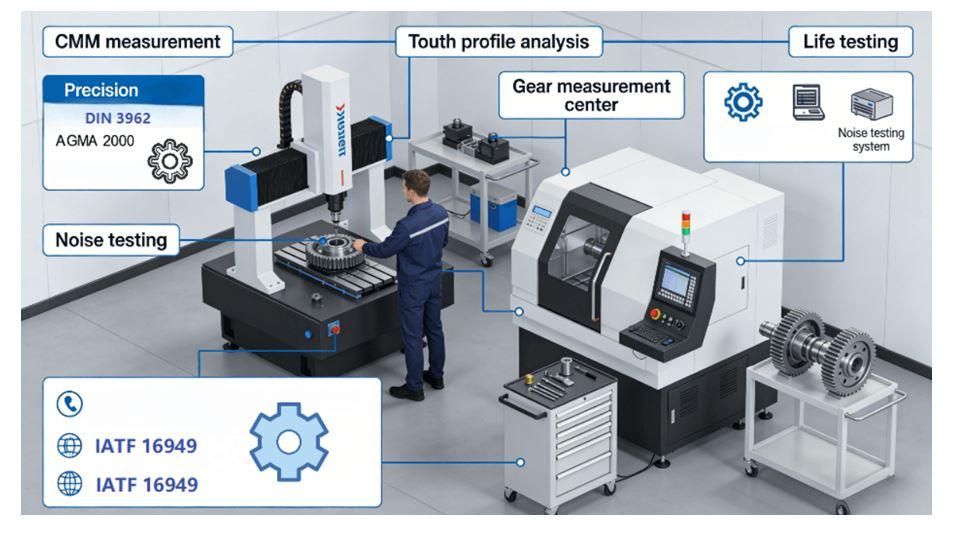
1. The Critical Role of Tooth Profile Accuracy and Statistical Process Control
Tooth profile errors should be within ≤0.003 mmto ensure smooth meshing and power transmission. The introduction of SPC in the manufacturing line allows the production to be monitored in real time and hence reduces variability. Even in automobile transmissions, very minor inaccuracies introduce noise and losses in transmission, requiring state-of-the-art metrology equipment.
2. Surface Roughness (Ra ≤0.4 μm) and Its Effect on Wear and Efficiency
Surface roughness, generally specified as Ra ≤ 0.4 μm, is a factor in low friction and wear resistance. However, the processes for surface roughness have to be optimized through grinding or honing. Preventing deviations from this requires a quality system in place. For high-speed applications, a smoother surface helps in low surface temperature formation.
3. Real-Time Compensation Methods for Improved Accuracy
In high-speed manufacturing, they employ real-time methods of compensation such as in-process gauging in an effort to compensate for both tool wear and thermal effects. They can thus sustain tolerancing across ±0.01 mm, a fact required in other industrial applications such as aeronautics. Through integrating all such methods, they accomplish a reduction in scrap and conformed specifications, as evident from their certification credentials.
What Methods Ensure an Accurate Gear Machining Quote While Balancing Cost and Quality?
Proper quotation can be a key factorin ensuring a project’s budgetary viability and compliance, but a host of suppliers ignore the cost factors in their solutions. A cost-effective model measuring various factors and ensuring alignment with requirements can add significant value and exclude rising costs in a solution from becoming an issue.
- Material Cost Analysis, considerations to Market Volatility Considerations: Cost of materials may range from 50% of total costsand may be influenced by factors such as the availability of certain alloys and disruptors of global supply chains. Historically observed price variations need to be taken into consideration by engineers to avoid the risks of price variations, and the risk may even reduce at least to 15%with localization of sourcing practices taken into consideration in case studies.
- Geometric Complexity-based Processing Time Calculations: Machining time depends on gear complexity, such as helical angles or internal keyways. Computer-aided manufacturing software simulations go hand in hand with estimates of how many hours a project will take, accounting for multi-axis machiningneeds. Following the systematic process presented in the frameworks for selecting gear machining services helps avoid underestimations, which usually result in hurried jobs and compromise on quality.
- Integration of Heat Treatment and Cost of Secondary Operation: Similarly, heat treatment processes, such as carburizing, add a great deal of expense but are necessary to provide the required durability. Quotes must itemize these steps, and secondary operations such as deburring or coating. Through the use of a TCO perspective, engineers can evaluate suppliers holistically and ensure that low initial quotes do not conceal long-term expenses. Effective pricing methodology draws on approaches from the standards leading into industry.
How to Determine Whether a Gear Machining Service can be Reliable and is Technically Suitable?
A reliable selection encompasses verifying technical capabilities, quality systems, and project management skills. A structured evaluation framework minimizes risks and ensures alignment with project goals.
1. Equipment Verification Through Precision Audits of the CNC Machines
Providers shall demonstrate the accuracy of CNC machine certifications to include spindle runout and positional tolerance. An on-site audit will verify the condition of the equipment, such as 5-axis grinders for complex geometries. For example, a minimum Cpk value of ≥1.67for critical dimensions suggests process capability, reducing defects.
2. Quality Certifications such as ISO 9001 and IATF 16949
Certifications like ISO 9001provide an excellent level of quality assurance, while IATF 16949is a mandatory standard in the automobile sector. Notions of improvement and preventing defects are assured with the certification. “A good partner will have solutions customized according to clients’ requirements with offerings professional gear services.
3. Project Execution Metrics Including On-Time Delivery and Communication
Consider historical performance metrics like on-time delivery rates at or above 95% and issue-resolution communication processes. Case studies that discuss successful scale-ups for large volume orders could imply a positive indication. By focusing on who has transparent reporting, engineers could establish a level of trust to either save or meet project deadlines.
What Are the Benefits of Custom Gear Solutions to Unique Operational Challenges?
Whenever certain operational requirements cannot be met with stock parts, custom gearsare utilized. They offer improved performance and durability. Custom gears find use in specific niches where standard gears just are not as effective.
- Noise Reduction up to 5 dB Through Tooth Profile Optimization: In the usage of robots and/or electric vehicles, specialized gearings with optimal tooth geometry result in the suppression of noise emissions by 3 to 5 DB. This is achieved through lead crowning for the reduction of vibrations, as seen in projects where the life of customized components was increased by two times.
- Enhanced Load Capacity for Heavy-Duty Industrial Applications: Custom-designed solutions can be upgraded with respect to material, or geometric changes can be made to support increased torque loads. For instance, in wind turbine gearboxes, custom-designed solutions are able to sustain varying loads, with the effect being reduced maintenance cycles.
- Integration with System-Level Design for seamless Performance: By doing so, in the initial phases of the process, custom gears can be made compatible with each other in such a way that no issues related to their counterparts would be experienced. This would further make it easier for the gears to fulfill the requirements for operating in a precise device, having a positional accuracy of ±0.001 mm.
How Do Advanced Certifications Such As ISO and AS9100D Improve The Quality Of Gear Production?
Certifications provide a structured way of implementing quality assurance and help ensure consistency and adherence to industry standards. Their application is far beyond the mere provision of a logo of excellence and instead provide an indication of the potential of the service for the production of credible outcomes.
1. Function of ISO 9001 in Defect Elimination and Process Standardization
ISO 9001 not only emphasizes the need for processes to be documented and audited but has helped minimize defects to below 1%in plants that have been certified. This is simply because it focuses on “customer focus” and “corrective actions.”
2. AS9100D for Aerospace and its Importance of Traceability
AS9100D introduces the most stringent standards for traceability to the aerospace industry. This makes it possible to trace every gear back to the manufacturing process. This is important for the industry as it deals with issues of health and safety.
3. The Impact of Certification upon Risk Mitigation and Supplier Selection
IATF 16949-type certifications reduce risks by enforcing preventive measures rather than reactive fixes. Engineers, when sourcing suppliers, should look first to those who hold relevant certifications. Certification demonstrates responsible quality culture and long-term partnership aspects.
Conclusion
A structured approach in the selection of gear machining services, considering industry-specific requirements and technical specifications, integrated with cost optimization, reduces up to 30% of the risks for the projects. By applying frameworks that focus on precision and reliability, engineers increase supply chain efficiency and innovation. This approach ensures that the manufactured gears meet exacting standards to realize overall manufacturing excellence.
FAQs
Q1: What is the first step in selecting a gear machining service?
A:The initial step would be the determination of the requirements based on the industry, including tolerances(like DIN-6 for automotive) and material specifications. Consult ASME Y14.5 standardsto avoid any mistakes in design.
Q2: What methods ensure accurate costing in the gear machining quote process?
A:Use a data-driven approachthat takes into account the volatility of materials and overheads. Research shows that it can cut TCO by 15%because it helps eliminate intangible expenses.
Q3: What are the most important requirements for certification in precision gear production?
A:ISO 9001is an indicator of quality management, and IATF 16949is an integral part of its implementation in the automotive sector. The certifications ensure that defects are less than 1%.
Q4: Why are custom gear solutions important for robotics?
A:Custom gears solve specific requirements for position accuracy to 0.001mmand noise suppression and improve the life of the joints of a robot by 2x.
Q5: How do I validate a supplier’s technical capability?
A:Perform audits on equipment (such as CNC grinders) and SPC data analysis. A good supplier should have Cpk values ≥1.67 for critical part characteristics.
Author Bio
The author is a Precision Manufacturing Specialist at LS Manufacturing. It is a contract manufacturing company that partner’s with engineers to overcome complex gear challenges in automotive, aerospace, and industrial applications. With certifications such as ISO 9001:2015, IATF 16949:2016, and AS9100D, a high-quality solution through advanced technologies is ensured. Contact them today for a free project review and DFM analysis. To turn your ideas into affordable realities.
