

Running a business today means managing more customer interactions than ever before—emails, chats, social media messages, support tickets, and the occasional phone call for good measure. Without a centralized system, it becomes surprisingly easy to lose track of details that matter, like who asked for a quote last week or which contact is ready for a follow-up call.
That’s where a CRM system becomes more than just a tool; it becomes a reliable partner that keeps your customer relationships moving smoothly. A good CRM example gives you clarity, structure, and confidence, allowing you to focus less on tracking information and more on building genuine connections.
The five CRM platforms in this list approach customer management in different ways, but they all revolve around the same goal: helping you understand, organize, and engage your audience with less effort.
Whether you’re nurturing leads, managing ongoing deals, or simply trying to keep communication consistent across your team, the right CRM can make an enormous difference. In this guide, we’ll walk through five well-known platforms to help you decide which suits your purpose the best. So let’s dive in.
SendPulse
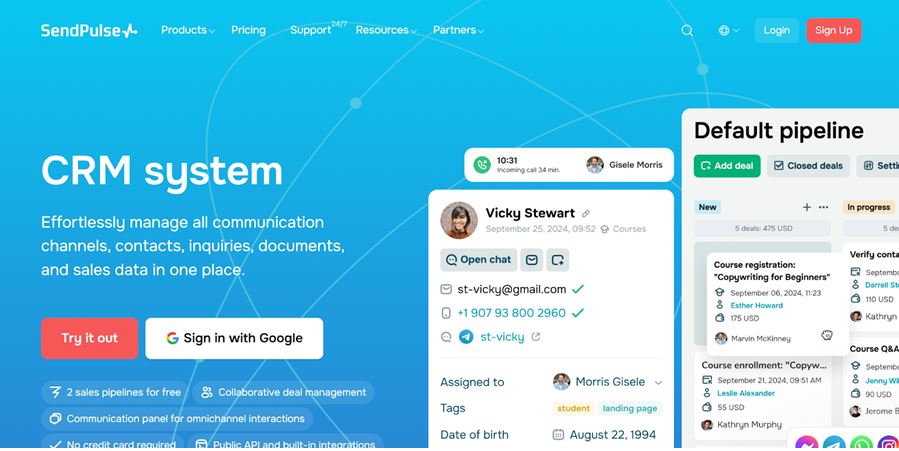
SendPulse immediately feels approachable for any business owner who wants an all-in-one solution that doesn’t require technical setup or a complicated learning curve. It brings sales, marketing, and communication together in one environment, which makes it feel like a natural extension of how a team already operates. Most users appreciate how it balances ease of use with genuinely powerful features that support contact management, automation, and multichannel communication. If you’re looking for a CRM that quietly makes your work simpler without forcing you to rethink your entire process, SendPulse is an especially strong candidate.
Pricing model
SendPulse offers a free plan that includes account owner and 4 invited users, 2 sales pipelines, 2 boards, and 5 flows, 1 event and 50 elements in Automation 360. The cheapest paid plan will cost you $12/month for 1 user, 2 sales pipelines, 2 boards, 8 flows, 5 events, and 50 elements in Automation 360.
Contact & account management
You can centralize contact details with custom fields and segmentation tools, making it easier to organize customers based on real business logic. These details flow naturally into other parts of the system, reducing repetitive work.
Marketing automation
SendPulse includes visual flow automation, letting you build intuitive customer journeys with conditions, delays, and branching logic. Even complex workflows feel manageable thanks to the clear interface.
Multichannel communication
One of the most notable strengths is its wide communication range—email, SMS, WhatsApp, Instagram, and even chatbots. This helps businesses maintain consistent outreach without switching tools.
Lead & deal management
Pipeline management supports customizable stages, deal timelines, automation rules, and clear visibility into team performance. It’s practical enough for sales teams but simple enough for beginners.
Reporting & analytics
Reports are built with clarity in mind—tracking conversions, funnel movement, and activity across channels. Real-time updates help businesses react quickly.
Overall, SendPulse positions itself as the most balanced CRM, combining generous free access, multichannel communication, and automation flexibility in a way most competitors struggle to match.
Mailchimp
Mailchimp tends to feel like a familiar name for business owners who have dabbled in marketing tools before. While it’s widely known for email marketing, its CRM features sit naturally inside the platform and benefit from the same polished interface. The system feels friendly and approachable, especially for users who want light CRM capabilities while primarily focusing on audience-based campaigns. If your workflow is centered around marketing outreach with occasional CRM needs, Mailchimp may feel like a comfortable fit.
Pricing model
Mailchimp’s CRM is integrated into its paid marketing plans, so you scale your features as your marketing needs grow. The free tier offers limited CRM capabilities, and 500 contacts. Paid tiers start from $13 per month for advanced templates, email scheduling, and access to automation workflows, 3 seats, and 2 roles.
Contact & account management
Contact profiles are highly detailed, with audience tags, segment options, and behavioral insights based on engagement history.
Marketing automation
Mailchimp includes prebuilt automation templates for nurturing, onboarding, and retention. These automations tend to focus heavily on email journeys.
Multichannel communication
Primarily centered on email, with additional options for web retargeting, social posting, and SMS depending on the plan.
Lead management
Lead scoring is available, and users can set up basic workflows to move people through the funnel, though the structure is more marketing-focused than sales-focused.
Reporting
Reports highlight campaign performance and audience engagement with visual clarity.
Mailchimp stands out most for businesses that treat marketing as the center of their customer experience and want CRM features that support a marketing-first workflow.
Constant Contact
Constant Contact presents itself as a CRM-plus-marketing environment that emphasizes ease of use and consistency. For many small businesses, it feels like a reliable starting point, especially for those who rely heavily on email campaigns and straightforward contact management. It blends email tools, surveys, and basic automation into a single workspace. Business owners often appreciate its predictable, steady approach.
Pricing model
The platform provides its new users with a 14-day free trial. After that, paid tiers start from $12 per month for 500 contacts, basic CRM tools, customizable email templates, and social media integrations.
Contact management
The CRM includes central storage for contact data, segmentation, and interaction history.
Marketing automation
Automation tools include autoresponders and simple multi-step sequences for common nurturing flows.
Communication channels
Primarily email-centered, with event management and survey add-ons to expand interactions.
Lead management
Contacts can be grouped, tagged, and nurtured, though the tool is not designed as a complex sales CRM.
Reporting
Analytics focus on email engagement, contact growth, and customer behavior.
Constant Contact works well for businesses that want a dependable email-centric CRM environment without needing deeper sales-oriented functionality.
Brevo
Brevo (formerly Sendinblue) approaches CRM from a perspective of efficiency and flexibility, making it feel approachable for teams of all sizes. Its blend of email, SMS, marketing automation, and sales pipelines creates a cohesive workflow that’s easy to adopt. Many business owners appreciate Brevo’s clean interface and focus on practical, everyday tasks.
Pricing model
The platform offers 50 open deals and one pipeline, which is great for beginners. Paid plans start at around $9/month for sales automation, unlimited deals and pipelines, unlimited connected calendars and mailboxes.
Contact management
Contact details, custom fields, segmentation tools, and activity tracking help marketers and sales teams build a clear picture of their audience.
Marketing automation
Brevo’s automation builder allows for multi-step workflows, conditions, and detailed branching, supporting a wide range of customer journeys.
Multichannel communication
Users can communicate through email, SMS, WhatsApp, and chat, creating a well-rounded outreach system.
Lead & deal management
Pipelines can be customized with drag-and-drop stages, team assignments, and follow-up reminders.
Reporting
Reports highlight engagement, automation performance, and sales pipeline movement.
Brevo is an appealing option for teams that want a flexible, modern CRM with communication channels tightly woven into the daily workflow.
ActiveCampaign
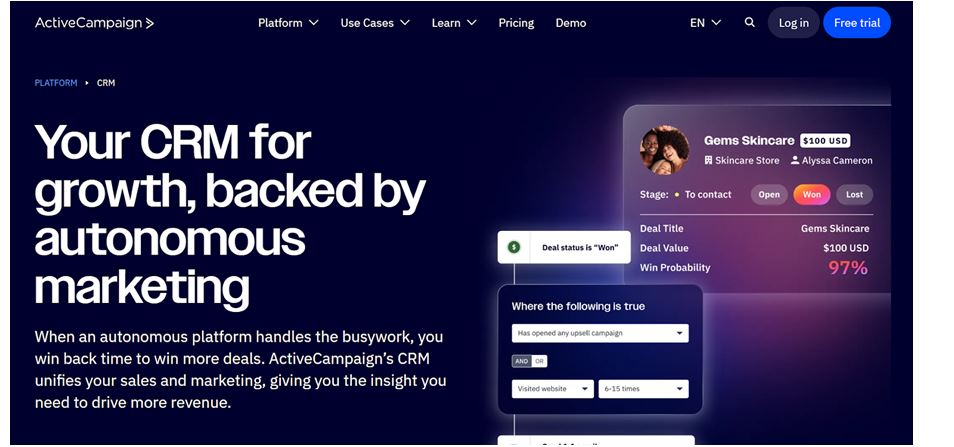
ActiveCampaign is known for blending marketing automation with CRM features in a way that appeals to users ready to invest in detailed customer journeys. Its tools feel well-suited for businesses that want to use behavior-based triggers and deeply personalized sequences. While the platform requires a bit more time to learn, many users appreciate the level of control it offers. For organizations that rely heavily on automation, ActiveCampaign often feels like a natural choice.
Pricing model
ActiveCampaign has a 14-day free trial instead of a free plan. Paid tiers start from $15/month and cover 1,000 contacts, 10,000 emails, and 5 actions per automation.
Contact management
ActiveCampaign keeps thorough customer profiles with tags, custom fields, and behavioral history.
Marketing automation
This is where the platform excels—its automation builder supports branching paths, scoring, triggers, and event-based flows.
Communication channels
Email is the primary channel, supplemented by site messages and SMS depending on the plan.
Lead management
Pipelines, scoring, and automated movement rules allow teams to prioritize and track sales opportunities.
Reporting
Detailed analytics support both marketing and sales insights.
ActiveCampaign is best suited for businesses with a strong focus on automated personalization and multi-step nurturing.
Final Thoughts
When looking across the five platforms, each one brings its own strengths to the table. Mailchimp offers a familiar environment for businesses already comfortable with email marketing. Constant Contact provides stability and simplicity for teams that want an email-focused CRM without excessive complexity. Brevo stands out for offering a genuinely usable free tier and intuitive multichannel communication, while ActiveCampaign caters to teams that want advanced automation and behavior-driven customer journeys. Each system has its own personality, and many businesses could find success with any one of them, depending on their priorities, for example, if you need a CRM that works with a chatbot builder platform.
However, SendPulse stands out as the most rounded and accessible option for most businesses. Its generous free plan, practical contact management system, flexible deal pipeline, and true multichannel communication offer a level of convenience that is hard to match. The built-in automations feel natural and intuitive, and the communication channels—ranging from email to chatbots to social messaging—provide a complete environment for both marketing and sales activity.
